
0
From AI That Answers Questions to AI That Takes Action EE404 is the most forward-looking course in GIEE’s AI in …
From AI That Answers Questions to AI That Takes Action
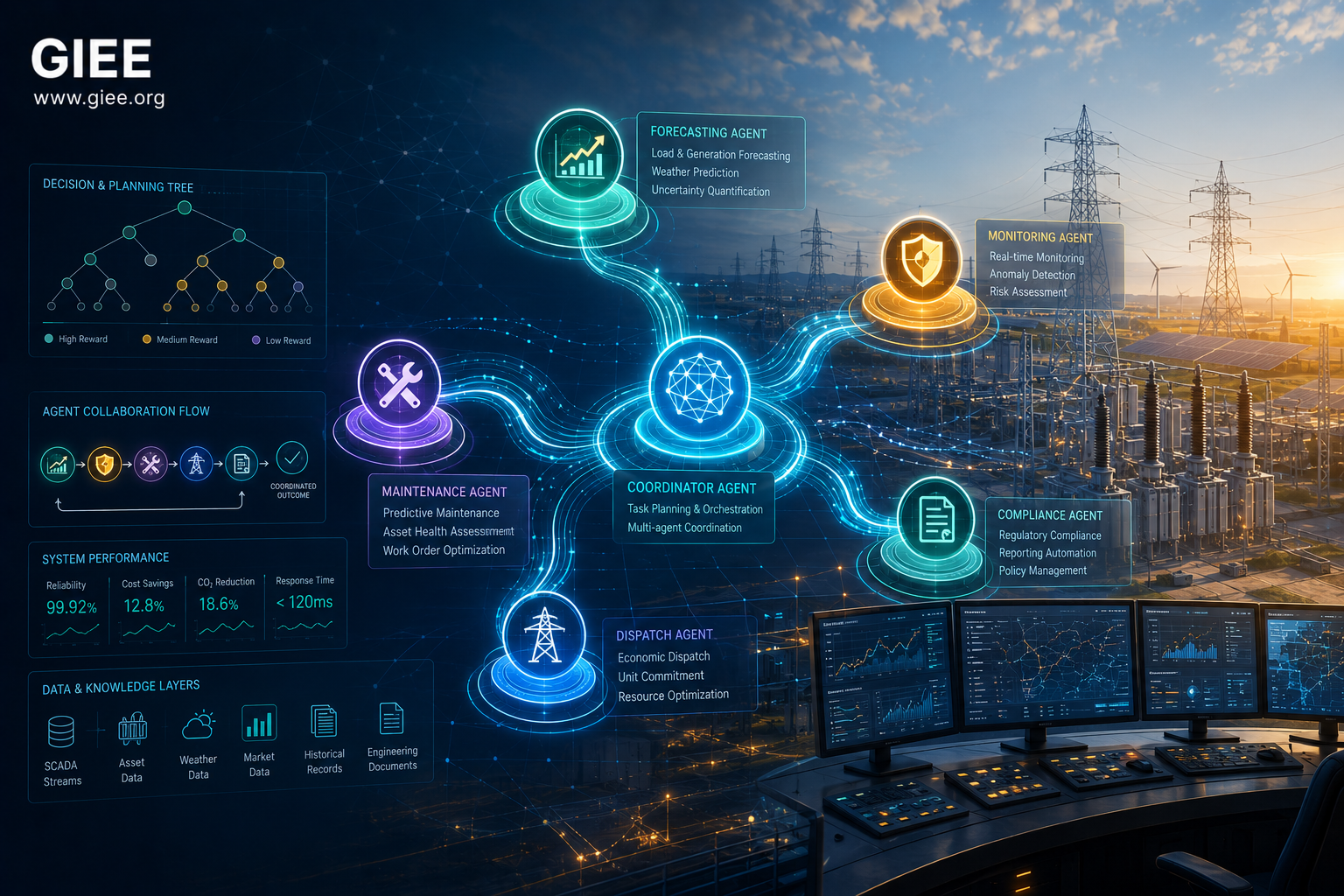
EE404 is the most forward-looking course in GIEE's AI in Energy Core curriculum. While EE403 teaches you to use LLMs to answer questions and retrieve information, EE404 takes the next step: AI systems that plan, take action, use tools, and learn from outcomes. This is the architecture of the AI agents that will increasingly characterize energy operations through 2030 and beyond.
You will learn how agentic AI systems are structured, when they are the right architecture (and when they are not), and how to design them safely for energy applications. The course covers single-agent systems with tool use, multi-agent coordination patterns, memory and planning architectures, and the human-in-the-loop safety patterns that are non-negotiable for energy infrastructure.
EE404 is required for both CAGP (Certified AI for Grid Professional) and CAEP (Certified AI for Energy Professional) certifications. Engineers who complete this course are equipped to design and reason about the autonomous systems that will increasingly handle forecasting, monitoring, maintenance coordination, and market participation across the energy sector.
What You Will Learn
- Distinguish traditional AI from agentic AI and identify when each architecture fits
- Design single-agent systems with appropriate memory, planning, and tool use
- Architect multi-agent systems that coordinate across forecasting, monitoring, maintenance, and market functions
- Implement human-in-the-loop safety patterns appropriate to energy operational contexts
- Apply leading agentic frameworks (LangChain, CrewAI, OpenAI Assistants) to energy use cases
- Evaluate when agentic AI is the right architecture versus simpler alternatives
- Recognize the failure modes specific to agentic systems and design safeguards against them
- Communicate the capabilities and limitations of agentic AI to non-technical stakeholders
Course Structure
EE404 is organized into four modules that progress from agentic foundations through multi-agent system design:
- Module 1: From AI to Agents — What makes a system "agentic." The agent architecture: LLM, goals, tools, memory, planning, safety. When agentic AI is the right answer and when it is not.
- Module 2: Building Single-Agent Systems — Tool use, function calling, ReAct patterns, memory architectures, and the practical mechanics of building a working agent. Hands-on with LangChain and OpenAI Assistants.
- Module 3: Multi-Agent Coordination — Coordination patterns, agent specialization, communication protocols, and orchestration. CrewAI and similar multi-agent frameworks. Energy use cases: forecasting agents, monitoring agents, maintenance agents working together.
- Module 4: Safety, Governance, and Human-in-the-Loop — The non-negotiable patterns for safety-critical applications. Approval gates, escalation paths, audit trails, kill switches. Why "fully autonomous" is the wrong goal for most energy applications.
Real-World Examples
Every concept is grounded in energy applications. Explore how an outage management agent might coordinate with a customer communications agent and a crew dispatch agent. See multi-agent architectures for distribution feeder monitoring with predictive maintenance escalation. Examine the safety patterns required when AI agents have the ability to actually open or close switches. Real architectures, real safety considerations, real engineering decisions.
Who This Course Is For
- Senior engineers and architects designing next-generation utility systems
- Engineering leaders evaluating agentic AI vendor proposals
- Innovation teams exploring autonomous systems for energy operations
- AI champions building the agent infrastructure for utilities or energy companies
- Engineers preparing for the next wave of operational AI deployment
- Anyone pursuing CAGP or CAEP certification
Prerequisites
- EE400 — AI and Machine Learning Fundamentals for Energy (required)
- EE401 — Deep Learning, LLMs and Generative AI for Energy (required; agentic AI is built on LLM foundations)
- EE403 — Prompt Engineering and RAG for Energy (strongly recommended; agents are essentially LLMs with tools and memory, so prompting skills transfer directly)
- Engineering or technical background
Format and Access
- Duration: Approximately 10 hours of content
- Format: Self-paced online with video instruction, demonstrations, and hands-on agent design exercises
- Course Access: 6 months of full access from enrollment
- Completion Window: 90 days to complete coursework and the final exam
- Assessment: 4 module quizzes (30% of grade) + comprehensive final exam (70% of grade)
- Passing Score: 70% overall
- Language: English
- AI Tools: Encouraged for learning and exercises; prohibited during quizzes and the final exam
Path to Certification
EE404 is the fifth course in GIEE's AI in Energy Core curriculum and contributes to two professional certifications:
- CAGP — Certified AI for Grid Professional: Complete the 9 Core courses (EE400 through EE408) plus the 3 Grid Add-On courses (EE410, EE411, EE412), then pass the CAGP certification exam.
- CAEP — Certified AI for Energy Professional: Complete the 9 Core courses (EE400 through EE408) plus the 3 Energy Add-On courses (EE420, EE421, EE422), then pass the CAEP certification exam.