
0
From Knowledge to Demonstrated Capability EE408 is the final Core course in GIEE’s AI in Energy curriculum and the applied …
From Knowledge to Demonstrated Capability
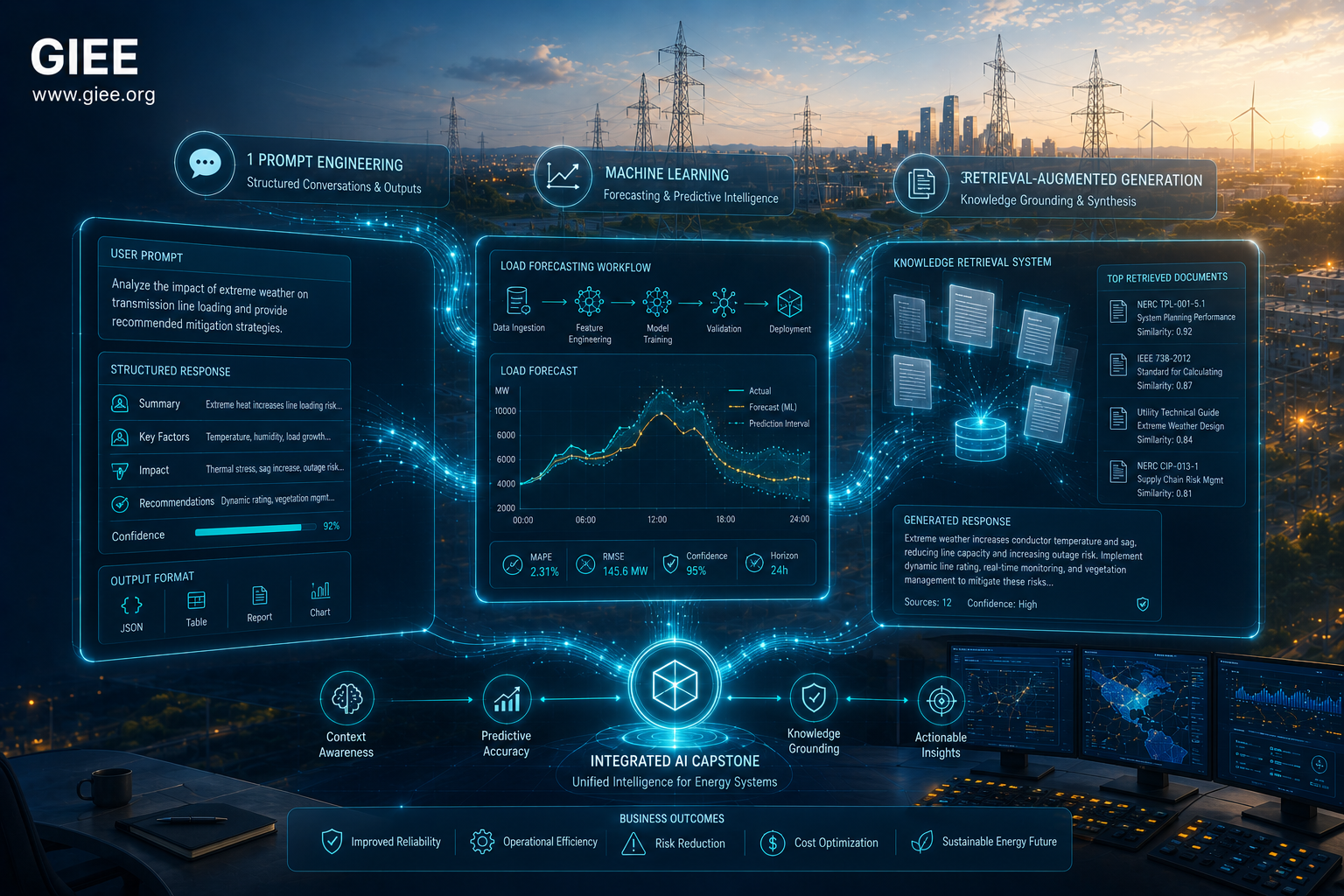
EE408 is the final Core course in GIEE's AI in Energy curriculum and the applied capstone that ties everything together. Where EE400 through EE407 build conceptual and technical capability, EE408 transforms that capability into demonstrated working AI systems. By the end of this course, you will have built, evaluated, and documented three substantial AI projects that integrate everything you learned across the Core.
Each capstone exercise is grounded in a realistic energy scenario. You will apply prompt engineering frameworks to a complete outage communication scenario, building deliverables for multiple audiences from operations through executives to regulators. You will build a complete load forecasting workflow in Python comparing classical methods against modern deep learning approaches with proper evaluation. You will construct a working RAG system on a real NERC standard with citations, source attribution, and accuracy evaluation.
The capstone exercises are designed to produce a portfolio of working AI projects you can use to demonstrate your capability — to your current employer, to prospective employers, and to the CAGP or CAEP certification examiner. EE408 is the course where AI in energy stops being something you study and becomes something you have demonstrably built.
EE408 is required for both CAGP (Certified AI for Grid Professional) and CAEP (Certified AI for Energy Professional) certifications. Strong EE408 capstone work is the most compelling evidence of certification readiness and serves as a portfolio piece for senior career opportunities.
What You Will Learn
- Apply prompt engineering frameworks to a real outage scenario with multi-audience deliverables
- Build and evaluate a complete load forecasting workflow in Python
- Compare AI approaches against traditional engineering baselines using appropriate metrics
- Construct a working RAG system grounded in a real NERC standard
- Implement citation handling and source attribution in a production-style RAG pipeline
- Document AI work to standards appropriate for engineering peer review
- Present AI capabilities and limitations to non-technical stakeholders effectively
- Build a portfolio of working AI projects ready for CAGP or CAEP examination evidence
Course Structure
EE408 is organized into four modules: an integration overview followed by three substantial capstone exercises:
- Module 1: Capstone Integration Framework — How the three capstone exercises integrate the Core curriculum. Documentation standards, evaluation criteria, and the workflow for moving from concept to working system.
- Module 2: Capstone 1 — Prompt Engineering for an Outage Scenario — Apply the RCFT framework and advanced prompting techniques to a realistic major outage scenario. Build deliverables for operations, customer communications, executive briefings, and regulatory notifications.
- Module 3: Capstone 2 — Load Forecasting in Python — Build a complete load forecasting workflow with linear regression baseline and LSTM deep learning model. Compare results using MAE, RMSE, and MAPE. Document the engineering decisions throughout.
- Module 4: Capstone 3 — RAG System for NERC TPL-001 — Build a complete RAG system in Google Colab grounded in a real NERC reliability standard. Implement document ingestion, embedding, retrieval, generation with citations, and accuracy evaluation.
Real-World Examples
The capstone exercises are not toy problems. The outage communications scenario reflects actual utility incident response workflows. The load forecasting workflow uses real hourly demand data with weather features and validates against industry benchmark MAPE thresholds. The RAG system is built on a real NERC standard with actual technical content, not a synthetic document. Each capstone produces deliverables you could legitimately present in a professional setting.
Who This Course Is For
- Engineers who have completed EE400 through EE407 and are ready to integrate the curriculum
- Students preparing for the CAGP or CAEP certification examination
- Practitioners building a portfolio of working AI projects for career advancement
- Engineering teams using EE408 capstones as internal capability demonstrations
- Anyone seeking concrete evidence of AI capability for senior roles
Prerequisites
- EE400 — AI and Machine Learning Fundamentals for Energy (required)
- EE401 — Deep Learning, LLMs and Generative AI for Energy (required for the LSTM forecasting capstone)
- EE403 — Prompt Engineering and RAG for Energy (required for the prompt engineering and RAG capstones)
- EE402 — Explainable AI and MLOps (recommended for the evaluation and documentation standards)
- EE406 — Python AI Ecosystem and Cloud Platforms (recommended for the Python build environment)
- Comfort with running Python code in Google Colab or a local Python environment
Format and Access
- Duration: Approximately 8 hours of guided content plus substantial independent capstone work
- Format: Self-paced online with video instruction, hands-on capstone exercises, and submission-based evaluation
- Course Access: 6 months of full access from enrollment
- Completion Window: 90 days to complete coursework, capstone exercises, and the final exam
- Assessment: 3 capstone deliverables (60% of grade) + final exam (40% of grade)
- Passing Score: 70% overall
- Language: English
- AI Tools: Encouraged for capstone exercises (this course is about applying AI tools); prohibited during the final exam
Path to Certification
EE408 is the ninth and final course in GIEE's AI in Energy Core curriculum and contributes to two professional certifications:
- CAGP — Certified AI for Grid Professional: Complete the 9 Core courses (EE400 through EE408) plus the 3 Grid Add-On courses (EE410, EE411, EE412), then pass the CAGP certification exam.
- CAEP — Certified AI for Energy Professional: Complete the 9 Core courses (EE400 through EE408) plus the 3 Energy Add-On courses (EE420, EE421, EE422), then pass the CAEP certification exam.
Strong EE408 capstone work serves as portfolio evidence in the certification examination process and signals certification readiness to evaluators.