
0
The Flagship of the CAGP Specialization EE411 is the most distinctive course in GIEE’s AI in Energy curriculum and the …
The Flagship of the CAGP Specialization
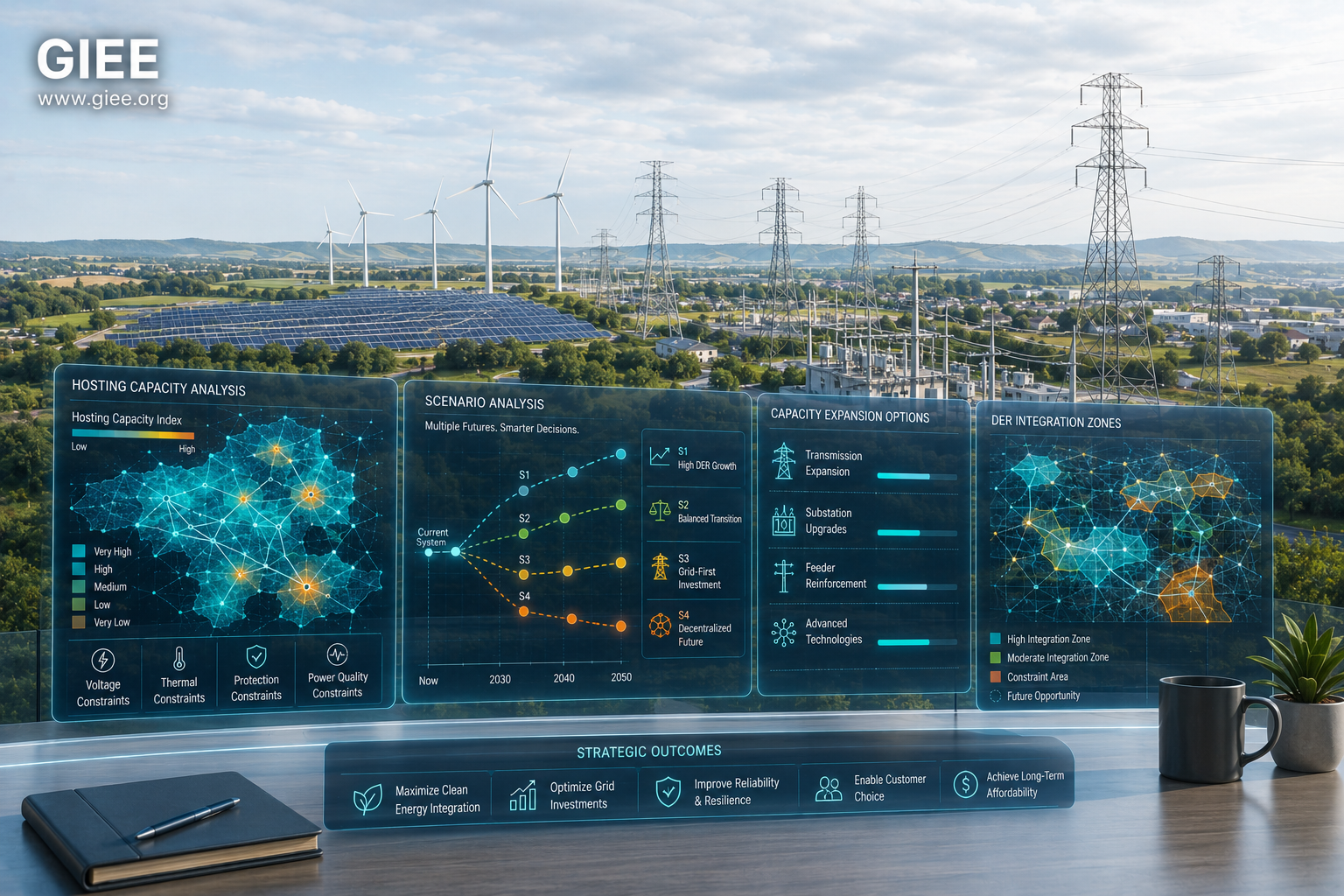
EE411 is the most distinctive course in GIEE's AI in Energy curriculum and the flagship of the CAGP (Certified AI for Grid Professional) specialization. While EE410 covers the operational layer of the smart grid, EE411 takes engineers into the planning and integration challenges that define the next decade of utility work: integrating distributed energy resources at scale, calculating hosting capacity dynamically, coordinating virtual power plants, and planning the grid of 2035 and beyond.
This is the course built directly on the founder's domain expertise. DER integration, hosting capacity analysis, and long-term system planning are areas where most utility engineers have practical questions that generic AI courses cannot answer. EE411 addresses those questions with the rigor and specificity that comes from working through these problems in the real world.
You will move from "we should integrate AI into planning" to detailed understanding of how AI augments hosting capacity analysis, how virtual power plants coordinate thousands of distributed resources, how AI changes integrated resource planning, and how machine learning addresses the uncertainty inherent in long-horizon planning. The course balances technical depth with practical applicability for utility engineers facing real DER integration projects.
EE411 is required for the CAGP — Certified AI for Grid Professional certification and is widely considered the highest-value course for utility engineers preparing for grid transformation work. Combined with the 9 Core courses and the other Grid Add-On courses (EE410 and EE412), EE411 forms a credential utility employers actively seek.
What You Will Learn
- Apply AI methods across the full DER integration lifecycle from interconnection through operations
- Build hosting capacity analyses augmented with machine learning techniques
- Design dynamic hosting capacity systems that update with changing grid conditions
- Architect virtual power plants that coordinate thousands of distributed resources
- Develop AI-driven integrated resource planning workflows for 10 to 30-year horizons
- Apply AI to capacity expansion modeling under uncertainty
- Communicate AI-augmented planning recommendations credibly to regulators and executives
- Recognize the limitations of AI in planning and where traditional methods remain superior
Course Structure
EE411 is organized into four modules covering the DER integration and planning landscape from short-term operations to multi-decade strategy:
- Module 1: DER Integration Fundamentals and AI — DER integration challenges. Where AI delivers value across the integration lifecycle: interconnection studies, technical screens, voltage analysis, fault current analysis. How AI changes the work of DER integration engineering.
- Module 2: Hosting Capacity Analysis — Traditional hosting capacity methods and their limitations. AI-augmented hosting capacity analysis. Dynamic versus static hosting capacity. The path from feeder-level to system-wide intelligent hosting capacity.
- Module 3: Virtual Power Plants and DER Aggregation — VPP architectures and coordination algorithms. AI for managing thousands of distributed resources at the operational tempo of the grid. Forecasting, optimization, and revenue stacking across multiple value streams.
- Module 4: AI-Driven System Planning — Integrated resource planning with AI augmentation. Capacity expansion modeling under uncertainty. Long-horizon planning for high-renewable, high-DER grids. Scenario analysis at scale. Communicating planning recommendations to regulators.
Real-World Examples
This course is grounded in real DER integration and planning work. Examine the AI-augmented hosting capacity analysis deployed by a major investor-owned utility that reduced interconnection study time by 60 percent. Review the virtual power plant architecture used by a regional aggregator coordinating 12,000 residential batteries and EVs. Explore an integrated resource plan that used machine learning to evaluate 10,000 capacity expansion scenarios at a level of detail traditional methods could not achieve. See how a transmission planner used AI for long-horizon scenario analysis under deep uncertainty about renewable adoption rates and electrification pathways.
Who This Course Is For
- DER integration engineers and DER planning engineers
- Utility planning engineers responsible for integrated resource plans
- Distribution planning engineers facing high DER penetration
- Transmission planning engineers working long-horizon studies
- VPP developers and operators
- Engineering leaders at utilities driving grid transformation
- Policy and regulatory professionals analyzing DER integration impacts
- Engineers preparing for CAGP certification
Prerequisites
- EE400 — AI and Machine Learning Fundamentals for Energy (required)
- EE405 — AI Across the Energy Value Chain (recommended for strategic context)
- EE410 — AI for Grid Operations and Smart Grid (recommended; complements the planning focus of EE411 with the operational focus)
- Engineering or technical background in electrical engineering, power systems, or utility planning
- Working knowledge of DER concepts, hosting capacity, or system planning is helpful but not required at an expert level
Format and Access
- Duration: Approximately 12 hours of content (longer than other Add-On courses, reflecting the depth of the topic)
- Format: Self-paced online with video instruction, demonstrations, and quizzes
- Course Access: 6 months of full access from enrollment
- Completion Window: 90 days to complete coursework and the final exam
- Assessment: 4 module quizzes (30% of grade) + comprehensive final exam (70% of grade)
- Passing Score: 70% overall
- Language: English
- AI Tools: Encouraged for learning and exercises; prohibited during quizzes and the final exam
Path to Certification
EE411 is the second of three Grid Add-On courses and a required course for CAGP certification:
- CAGP — Certified AI for Grid Professional: Complete the 9 Core courses (EE400 through EE408) plus the 3 Grid Add-On courses (EE410, EE411, EE412), then pass the CAGP certification exam. Total of 12 courses for the credential most valued by utility employers and grid-focused organizations.
EE411 is widely considered the highest-leverage course in the CAGP track because the topics it covers (DER integration, hosting capacity, virtual power plants, system planning) are precisely where utility hiring is most active and where AI capability differentiates candidates most clearly.