

0
The Course That Completes the CSPP Foundation EE202 is the third course of GIEE’s CSPP (Certified Solar PV Professional) track. …
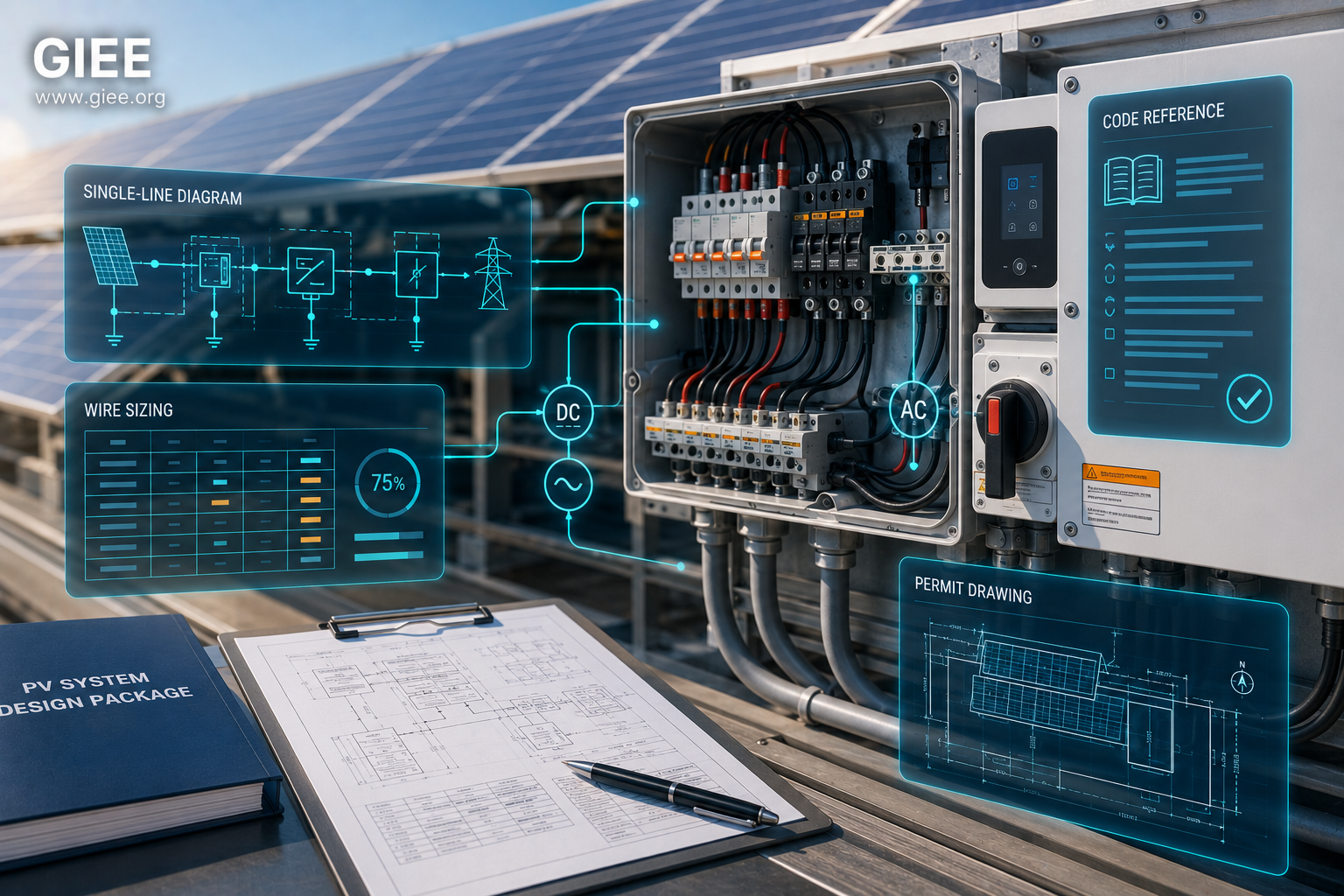
The Course That Completes the CSPP Foundation
EE202 is the third course of GIEE's CSPP (Certified Solar PV Professional) track. Where EE200 establishes solar PV fundamentals and EE201 covers detailed design and sizing, EE202 closes the gaps that turn a strong technical understanding into genuine professional capability: electrical design depth, comprehensive code mastery, utility interconnection, solar plus storage integration, and operations and maintenance.
Solar PV professionals need to do more than calculate system sizes. They need to design wire runs that pass inspection, size overcurrent protection correctly, navigate the full NEC requirements for PV and storage systems, complete utility interconnection successfully, and operate installed systems through their multi-decade life. These are the skills that separate engineers who can describe solar systems from engineers who can actually deliver them.
You will learn to apply NEC Articles 690, 705, and 706 in detail, design solar plus storage systems that meet code, navigate utility interconnection processes, perform commissioning and acceptance testing, and operate solar systems with the rigor required for multi-decade asset performance. Every concept is grounded in real installation scenarios and real engineering decisions.
EE202 is required for the CSPP — Certified Solar PV Professional certification. Combined with EE200, EE201, and EE203, the four-course CSPP track delivers the foundational professional capability that solar developers, engineering firms, and utility customer-side teams expect from a credentialed solar engineer.
What You Will Learn
- Apply detailed electrical design methods including wire sizing, voltage drop calculations, and overcurrent protection
- Implement grounding, bonding, and arc-fault protection per NEC requirements
- Master NEC Article 690 (PV systems), Article 705 (interconnected systems), and Article 706 (energy storage)
- Navigate utility interconnection processes including IEEE 1547 application and net metering
- Design solar plus storage systems with appropriate battery integration and protection
- Perform commissioning, acceptance testing, and IV curve analysis on installed systems
- Set up performance monitoring and operate solar systems through their multi-decade lifecycle
- Apply troubleshooting frameworks to common solar system issues
Course Structure
EE202 is organized into four modules covering the full electrical, code, interconnection, and operational spectrum of solar PV professional practice:
- Module 1: Detailed Electrical Design — Wire sizing for DC and AC sides. Voltage drop calculations and acceptable limits. Conduit fill and routing. Overcurrent protection sizing. Grounding and bonding per NEC 690.41 through 690.49. Arc-fault protection requirements and implementation.
- Module 2: Comprehensive Code Mastery — NEC Article 690 in depth: rapid shutdown, working clearances, marking, disconnects. NEC Article 705 for interconnected power production sources. NEC Article 706 for energy storage systems paired with solar. IFC fire code requirements for residential and commercial PV. AHJ-specific considerations and how to navigate them.
- Module 3: Interconnection and Solar Plus Storage — Utility interconnection process from application through approval. IEEE 1547 application for PV systems. Net metering structures and value-of-solar tariffs. Permit drawing requirements and submission. Solar plus storage system design with battery integration, protection, and operational coordination.
- Module 4: Commissioning, Performance, and Operations — Commissioning procedures and acceptance testing. IV curve testing methodology and interpretation. Monitoring system setup and ongoing performance tracking. Performance ratio analysis. Common system issues and troubleshooting frameworks. Warranty management and end-of-life planning.
Real-World Examples
Every concept is grounded in real solar installation and operations scenarios. Examine the electrical design package for a 50 kilowatt commercial rooftop installation showing wire sizing, OCPD selection, and conduit routing. Review a residential solar plus storage permit submission with the full set of drawings, calculations, and code references that satisfy AHJ requirements. Explore an utility interconnection application package for a one megawatt ground-mount system. Analyze the commissioning report and IV curve data from a recently energized 200 kilowatt installation. Review the performance ratio analysis and degradation tracking for a 10-year-old residential system. Real installations, real engineering deliverables, real operational decisions.
Who This Course Is For
- Engineers completing the CSPP certification track
- Solar design engineers responsible for permit-ready electrical drawings
- Project engineers managing solar installations through commissioning
- Operations and maintenance engineers responsible for installed solar fleets
- Utility engineers reviewing customer-side solar interconnection applications
- Engineering firm staff preparing for solar project deliverables
- Engineers preparing for advanced solar PV examinations and credentials
Prerequisites
- EE200 — Introduction to Solar Power Systems (required; foundational solar concepts)
- EE201 — Advanced Solar Power Systems (required; system design fundamentals)
- Engineering or technical background
- Basic electrical engineering concepts (voltage, current, wire ampacity, basic NEC familiarity is helpful)
Format and Access
- Duration: Approximately 10 hours of content
- Format: Self-paced online with video instruction, demonstrations, code reference walk-throughs, and quizzes
- Course Access: 6 months of full access from enrollment
- Completion Window: 90 days to complete coursework and the final exam
- Assessment: 4 module quizzes (30% of grade) + comprehensive final exam (70% of grade)
- Passing Score: 70% overall
- Language: English
- AI Tools: Encouraged for learning and exercises; prohibited during quizzes and the final exam
Path to Certification
EE202 is the third of four courses required for CSPP certification:
- CSPP — Certified Solar PV Professional: Complete EE200 (Introduction to Solar Power Systems), EE201 (Advanced Solar Power Systems), EE202 (Solar PV Electrical Design, Codes, and Operations), and EE203 (Solar PV Modeling, Simulation, and Energy Yield Analysis), then pass the CSPP certification exam. Total of 4 courses for the credential designed to prepare engineers for professional solar PV work.
Completing EE202 means students have completed three of the four courses required for the Certified Solar PV Professional credential. EE203 (Solar PV Modeling, Simulation, and Energy Yield Analysis) and the certification examination remain. The CSPP track delivers comprehensive solar PV engineering capability covering foundations, design and sizing, electrical and code compliance, and energy modeling.