

0
The Modeling and Simulation Skills Solar PV Professionals Need EE203 is the fourth and final course of GIEE’s CSPP (Certified …
The Modeling and Simulation Skills Solar PV Professionals Need
EE203 is the fourth and final course of GIEE's CSPP (Certified Solar PV Professional) track. Where EE200 establishes solar PV foundations, EE201 covers detailed design and sizing, and EE202 covers electrical design, codes, and operations, EE203 closes the track by teaching the modeling and simulation skills that validate solar PV designs and produce bankable energy yield estimates.
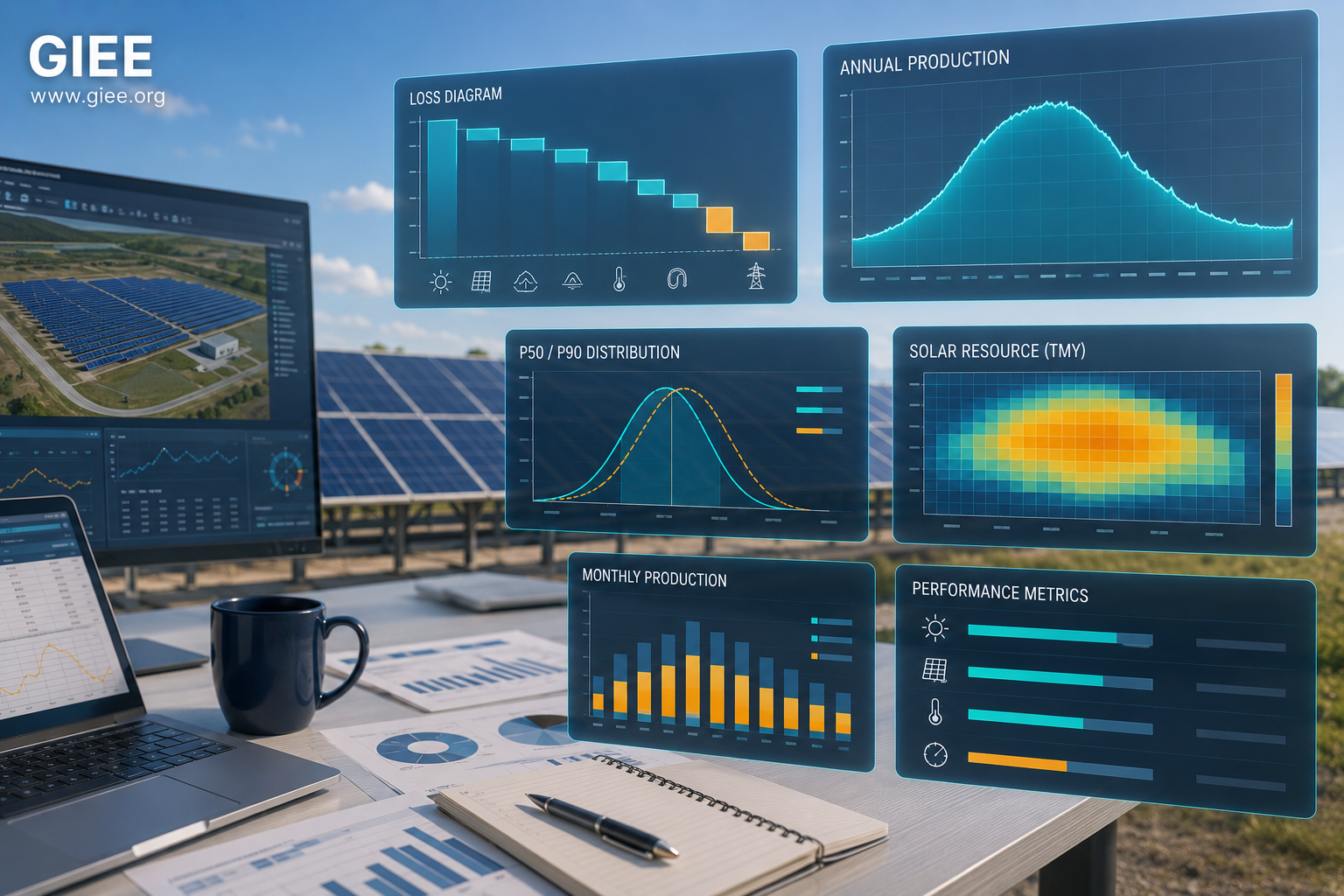
You will master the industry-standard tools that solar engineers use every day: PVsyst for detailed simulation, NREL's System Advisor Model (SAM) as a powerful free alternative, and the workflow concepts that apply across all major modeling platforms. You will learn to interpret loss diagrams, validate production estimates against measured data, perform P50/P90 analysis for project finance, and avoid the common modeling errors that produce misleading results.
Engineers who can produce credible, bankable energy yield estimates command premium rates and play essential roles on solar development teams. EE203 builds this capability through hands-on tool training combined with the methodology and judgment that separates production estimates that hold up under scrutiny from estimates that do not.
EE203 is required for the CSPP — Certified Solar PV Professional certification. Combined with EE200, EE201, and EE202, the four-course CSPP track delivers comprehensive solar PV engineering capability covering foundations, design and sizing, electrical and code compliance, and energy modeling.
What You Will Learn
- Apply solar resource data correctly: TMY datasets, P50/P90 distributions, satellite versus ground-measured data
- Identify and quantify the loss mechanisms that affect PV system production
- Build PVsyst projects from climate data import through detailed simulation results
- Interpret PVsyst loss diagrams to diagnose performance and identify optimization opportunities
- Use NREL's System Advisor Model (SAM) for solar simulation and financial analysis
- Choose the appropriate simulation tool based on project type, accuracy requirements, and resources
- Perform P50/P90 analysis for project finance and risk assessment
- Validate production estimates against measured data using performance ratio analysis
- Recognize and avoid the common modeling errors that produce misleading results
Course Structure
EE203 is organized into four modules covering the modeling and simulation landscape from energy yield fundamentals through advanced production validation:
- Module 1: Energy Yield Fundamentals — Solar resource data sources and quality (TMY, ground stations, satellite-derived datasets). Loss mechanisms in PV systems: shading, soiling, temperature, mismatch, wiring, inverter clipping, transformer losses, and availability. Performance ratio and capacity utilization factor as key performance indicators. What makes a production estimate "bankable" for project finance.
- Module 2: PVsyst Proficiency — PVsyst interface and project workflow. Climate data import and validation. System definition: modules, inverters, mounting, electrical configuration. Loss parameter configuration based on project type. Running simulations and interpreting results. Detailed loss diagram analysis. Worked case studies across residential, commercial, and utility-scale projects.
- Module 3: SAM and Tool Selection — NREL's System Advisor Model (SAM) interface and capabilities. When SAM fits versus when PVsyst is preferred. Brief overview of complementary design tools. Tool selection framework based on project requirements. Cross-tool consistency: ensuring different tools produce comparable results.
- Module 4: Advanced Modeling and Production Validation — Soiling and degradation modeling. Bifacial module simulation considerations. Single-axis tracking effects on production. P50/P90 analysis methodology for project finance. Production validation against measured data. Common modeling errors and how to avoid them. The judgment skills that separate confident estimators from cautious ones.
Real-World Examples
Every concept is grounded in real solar modeling scenarios. Work through PVsyst projects for a residential rooftop system, a 500-kilowatt commercial flat-roof installation, and a 10-megawatt utility-scale ground-mount with single-axis tracking. Examine the loss diagram analysis that revealed a 4 percent production gap explained by inverter clipping. Review the P50/P90 analysis used to support a 100-megawatt project finance application. Compare PVsyst and SAM simulation results for the same project and reconcile the differences. Real projects, real engineering decisions, real production validation work.
Who This Course Is For
- Solar engineers responsible for production estimates and energy yield reports
- Solar developers preparing project finance applications
- Engineering firm staff producing simulation deliverables
- Asset managers validating performance against design predictions
- Engineers transitioning into solar simulation and modeling roles
- Solar technical due diligence professionals
- Anyone pursuing CSPP certification
Prerequisites
- EE200 — Introduction to Solar Power Systems (required; foundational solar concepts)
- EE201 — Advanced Solar Power Systems (required; design and sizing concepts inform the simulation work)
- EE202 — Solar PV Electrical Design, Codes, and Operations (recommended; electrical design context supports the simulation modeling)
- Engineering or technical background
- Comfort with software tools at a working level (the course teaches PVsyst and SAM proficiency)
- Access to PVsyst is helpful for hands-on practice (not strictly required; the course can be completed using SAM for hands-on work since SAM is free)
Tools Covered
- PVsyst — The industry-standard simulation tool for detailed PV system modeling. Required for most commercial and utility-scale solar work and bankable production estimates.
- System Advisor Model (SAM) — NREL's free, open-source simulation platform combining technical and financial modeling. A powerful alternative to PVsyst for many use cases.
- Climate data sources — TMY datasets, NSRDB, Meteonorm, and satellite-derived solar resource data.
- Performance analysis frameworks — Methodologies that apply across all major simulation tools.
Format and Access
- Duration: Approximately 10 hours of content
- Format: Self-paced online with video instruction, software demonstrations, worked simulation examples, and quizzes
- Course Access: 6 months of full access from enrollment
- Completion Window: 90 days to complete coursework and the final exam
- Assessment: 4 module quizzes (30% of grade) + comprehensive final exam (70% of grade)
- Passing Score: 70% overall
- Language: English
- AI Tools: Encouraged for learning and exercises; prohibited during quizzes and the final exam
Path to Certification
EE203 is the fourth and final course required for CSPP certification:
- CSPP — Certified Solar PV Professional: Complete EE200 (Introduction to Solar Power Systems), EE201 (Advanced Solar Power Systems), EE202 (Solar PV Electrical Design, Codes, and Operations), and EE203 (Solar PV Modeling, Simulation, and Energy Yield Analysis), then pass the CSPP certification exam. Total of 4 courses for the credential designed to prepare engineers for professional solar PV work.
Completing EE203 means students have completed the full CSPP coursework. The CSPP certification examination becomes the final step toward earning the Certified Solar PV Professional credential.