

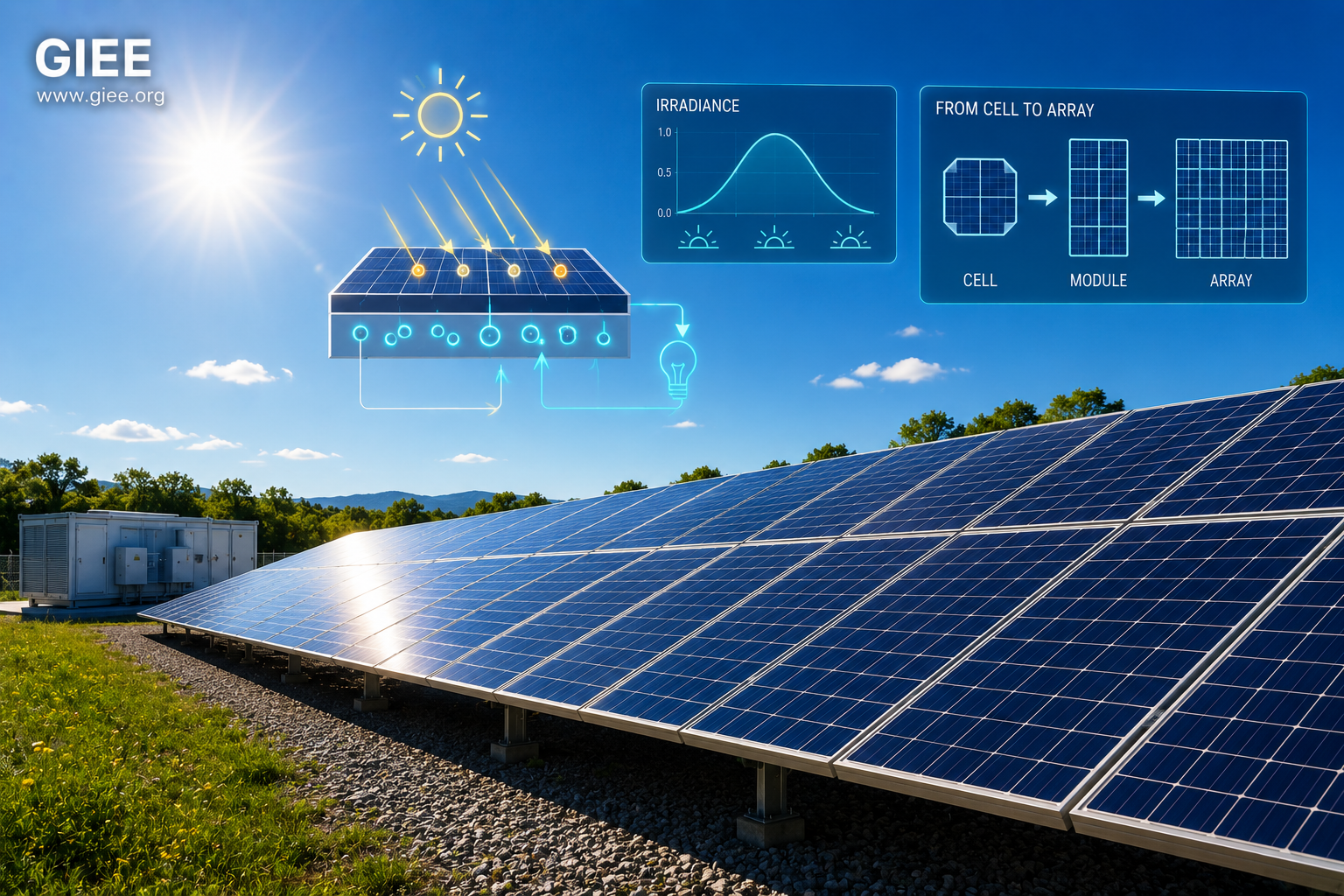
This course includes
- 15 hours of structured instruction
- Self-paced online learning
- 4 modules with video lessons
- 4 module quizzes and a final exam
- 70% passing score
- Verifiable certificate with serial number
- Earn PDHs upon completion
- 6 months of course access
Your Certificate
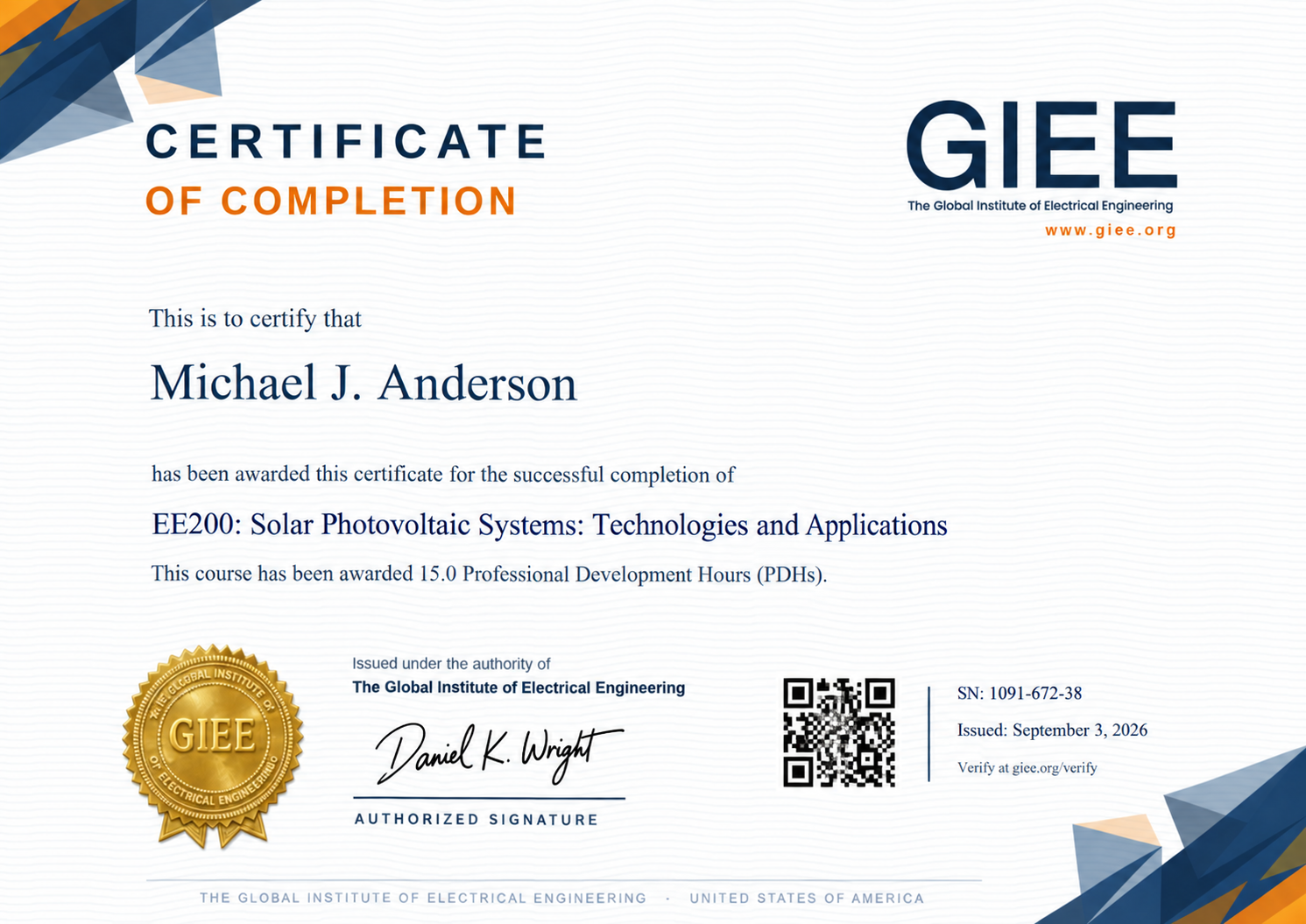
Sample certificate. Every GIEE certificate carries a unique serial number and can be verified at giee.org/verify.
Solar has moved from a specialty technology to a core part of how electricity is generated and delivered. EE200 gives engineers and energy professionals a complete working picture of solar photovoltaic systems: the physics that makes them work, the technologies that make them viable, and the architectures that put them into service.
The course opens the GIEE Solar PV series. It moves from the behavior of the solar resource through cell, module, and array technology, into the grid-tied, off-grid, and hybrid architectures deployed today, and on to the components, site assessment methods, code requirements, and performance concepts that turn site potential into an operating system.
The treatment is deliberately balanced: accessible to professionals arriving from adjacent fields, and rigorous enough that engineers already working in solar leave with a sharper technical model than they came in with. Every concept is taught against real installations and the engineering decisions behind them.
What You Will Learn
- Explain solar resource behavior and how irradiance varies with location, season, and time of day
- Describe PV cell, module, and array technology, including silicon types, thin film, and emerging chemistries
- Distinguish grid-tied, off-grid, and hybrid architectures and identify where each one fits
- Identify the components of a complete installation: modules, inverters, mounting, and balance of system
- Apply site assessment methods to evaluate solar potential and recognize the constraints that limit it
- Recognize the NEC requirements and safety considerations that shape every PV installation
- Interpret performance, efficiency, and energy yield concepts and the factors that drive each
- Communicate solar PV concepts clearly to customers, regulators, and project stakeholders
Course Structure
EE200 is organized into four modules that move from physics through applications.
- Module 1: Solar Physics and PV Technology. How sunlight becomes electricity. PV cell physics, module and array construction, silicon types, thin film, and emerging chemistries: the technical vocabulary every solar professional works in.
- Module 2: System Types and Architectures. Grid-tied, off-grid, and hybrid configurations across residential, commercial, and utility-scale applications, and the architectural decisions that shape every solar project.
- Module 3: Components and Site Assessment. Modules, inverters, mounting systems, and balance of system equipment, paired with site assessment fundamentals: solar resource, shading, and structural considerations.
- Module 4: Code Basics, Safety, and Performance. NEC requirements relevant to PV, safety essentials for installation and operation, and the performance, efficiency, and energy yield concepts used to evaluate a system.
Grounded in Real Installations
Every concept is illustrated with systems that were actually built. Residential rooftop arrays show how module orientation, mounting choice, and inverter selection interact. Commercial flat-roof installations bring in shading challenges and string design constraints. Utility-scale solar farms demonstrate single-axis tracking and centralized inverter architecture. Off-grid systems show what changes when there is no utility connection to lean on. Real installations, real engineering decisions, real performance data.
Who This Course Is For
- Engineers entering solar from other disciplines
- Engineering graduates building solar capability
- Solar sales and business development professionals who need genuine engineering depth
- Project managers responsible for solar installations
- Utility engineers evaluating customer-side solar interconnection
- Energy professionals in adjacent fields assessing solar opportunities
Prerequisites
- An engineering or technical background in any discipline
- Algebra and basic physics concepts
- No prior solar industry experience required
- No electrical engineering specialization required; the course develops the electrical concepts it depends on
Format and Access
- Duration: 15 hours of structured instruction
- Format: Self-paced online, with video instruction, demonstrations, and quizzes
- Access: Six months of full access from enrollment
- Completion window: 90 days to complete the coursework and the final exam
- Assessment: Four module quizzes (30% of grade) and a comprehensive final exam (70% of grade)
- Passing score: 70% overall
- Language: English
- AI tools: Encouraged for learning and exercises; prohibited during quizzes and the final exam
Where This Course Leads
EE200 is the first of four courses in the GIEE Solar PV series. Together they build progressive capability across the full arc of solar engineering work.
- EE201: Advanced Solar Power Systems. Deeper system design and sizing, string configuration, and inverter selection.
- EE202: Solar PV Electrical Design, Codes, and Operations. Electrical design detail, code compliance, and operational practice.
- EE203: Solar PV Modeling, Simulation, and Energy Yield Analysis. Performance modeling and energy yield analysis using industry-standard tools.
Each course stands on its own. Taken in sequence, they deliver the integrated skill set expected in professional solar roles across development, design, project engineering, and operations.