

Key Takeaways
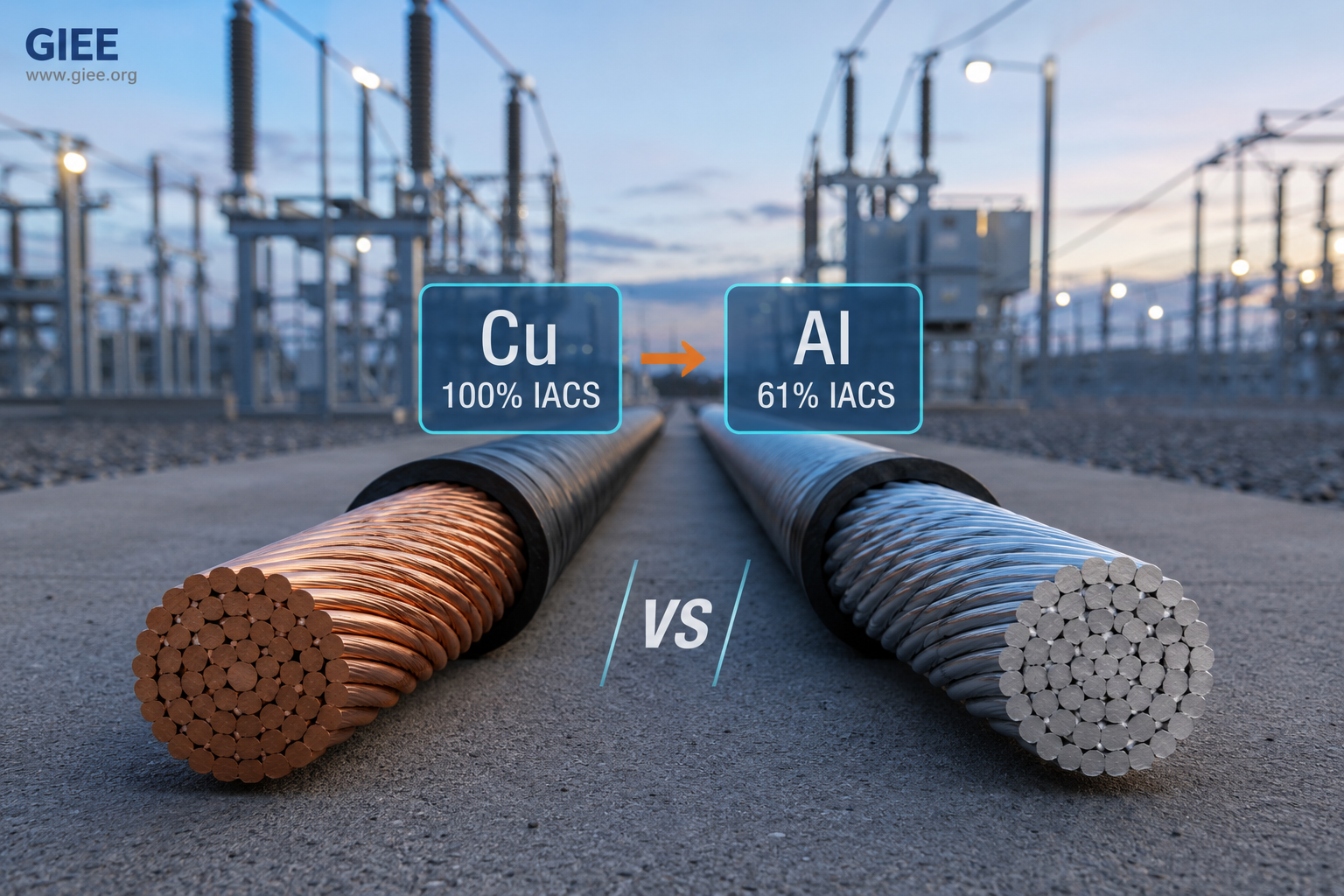
- Aluminum conducts at roughly 61% of copper by cross section, so an aluminum conductor must be about 1.6 times larger in area to match copper’s resistance.
- Even after upsizing, that aluminum conductor weighs roughly half as much and costs several times less in raw metal – the reason it dominates overhead lines and large feeders.
- Copper wins where space, terminations, reliability, and long service life matter more than metal cost: motors, control wiring, data centers, and tight conduit runs.
- Most aluminum failures are connection failures, not conductor failures. Oxide films, creep, and thermal cycling are managed by correct terminations, not avoided by picking copper.
- The right answer is application-specific. Judge the installed system, not the price of the metal.
Two Metals, One Recurring Decision
Few material choices show up as often, or carry as much cost leverage, as copper versus aluminum for electrical conductors. It appears in a residential service entrance, a 500 MW solar collection system, an industrial motor feeder, and every kilometer of overhead transmission line. With electrification driving conductor demand upward and metal prices swinging year to year, getting this choice right has real consequences for cost, losses, weight, and reliability.
The instinct that “copper is better” is not wrong on pure conductivity – but it is an incomplete answer. Working engineers do not choose a metal in isolation; they choose an installed system that has to meet ampacity, voltage drop, mechanical, thermal, and economic constraints at once. This article walks through the engineering trade-offs and where each material genuinely earns its place.
The Physics: Conductivity, Weight, and Size
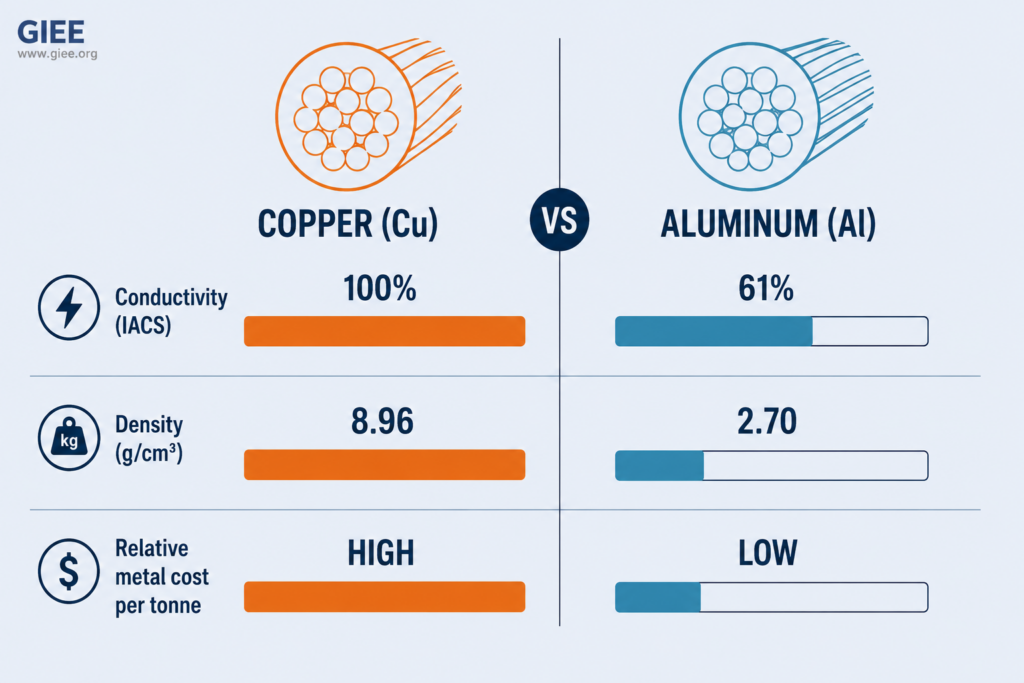
Copper’s advantage starts with resistivity. Annealed copper is the reference point for conductivity, defined as 100% IACS (International Annealed Copper Standard), with a resistivity near 1.68 × 10⁻⁸ Ω·m. Electrical-grade aluminum (alloy 1350) sits around 61% IACS, close to 2.82 × 10⁻⁸ Ω·m. Aluminum simply moves less current through the same cross-sectional area.
Conductor resistance follows a relationship every EE knows:
Because aluminum’s resistivity is higher, matching a given copper conductor means increasing the area by about 1 / 0.61, roughly a factor of 1.6. In practical terms, an aluminum conductor is usually sized one to two standard sizes larger than the copper it replaces for the same current and voltage drop.
Here is where aluminum turns the tables. Copper’s density is about 8.96 g/cm³; aluminum’s is only 2.70 g/cm³, roughly one-third. Even after upsizing the area by 1.6, the aluminum conductor still lands at about half the mass of the equivalent copper conductor (1.6 × 2.70 / 8.96 ≈ 0.48). That single fact – lighter metal despite a larger body – drives most of aluminum’s structural and economic wins.
Putting Numbers to It
The following illustrative comparison shows why aluminum keeps winning on large runs. It is meant to build intuition, not to replace a proper ampacity and voltage-drop study.
Cost and the Economics of Scale
On a per-tonne basis, copper has typically traded at three to four times the price of aluminum. Because conductor spend scales with mass and length, that ratio is why aluminum has been the default for overhead transmission and distribution for decades. Utilities move enormous volumes of conductor across the landscape; halving the weight and cutting metal cost several-fold changes the economics of an entire build.
The nuance every practitioner learns: metal cost is not installed cost. Aluminum’s larger cross section can require larger conduit, larger terminations, and sometimes an extra size of raceway. In a tight commercial riser, those knock-on costs can erase the metal savings. The economic case for aluminum strengthens as runs get longer, quantities get larger, and space gets less constrained.
The Practical Catch: Connections and Thermal Behavior
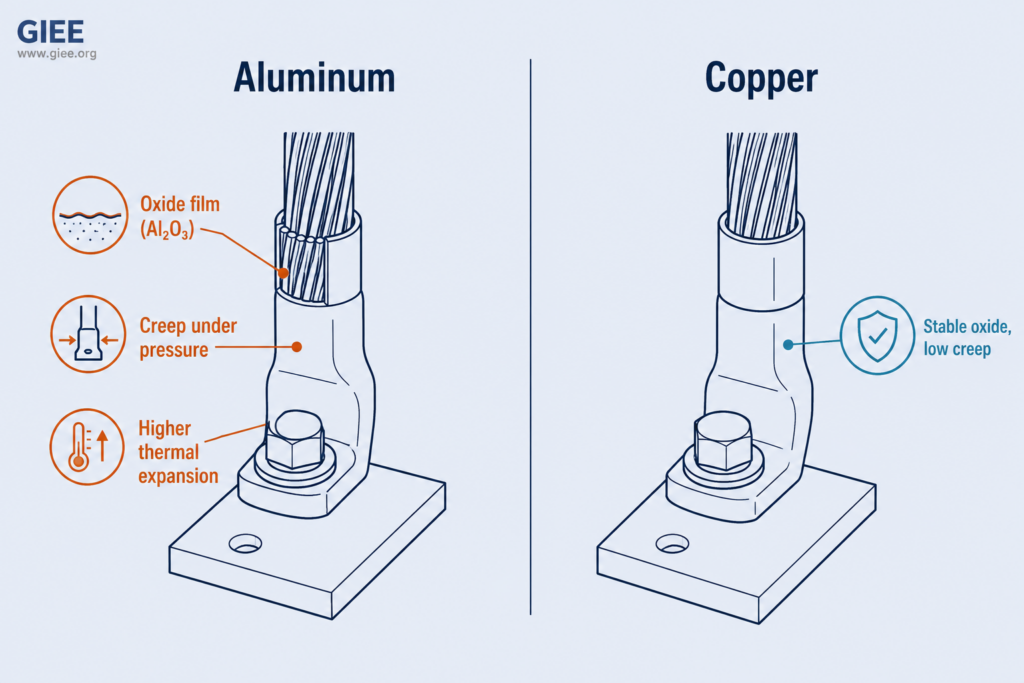
Aluminum’s real engineering challenge is not carrying current – it is staying connected. Three effects matter. First, aluminum forms a hard, insulating oxide (Al2O3) almost instantly on exposure to air, so a poorly prepared termination starts life with elevated contact resistance. Second, aluminum is prone to cold flow, or creep, under sustained mechanical pressure, so a joint torqued once can loosen over time. Third, aluminum expands and contracts more with temperature – about 23 × 10-6 per °C versus copper’s 17 × 10-6 per °C – so thermal cycling works a joint loose faster.
None of this makes aluminum unusable. It makes terminations the design focus: rated connectors, antioxidant compound where specified, correct torque, and materials qualified for aluminum contact. Mixing copper and aluminum at a connection without a rated bimetallic connector invites galvanic corrosion and is a classic field failure.
Where Each Material Wins
Rather than a universal winner, think in terms of which constraint dominates the application. The table below summarizes how the trade-offs usually resolve.
| Factor | Copper | Aluminum |
|---|---|---|
| Conductivity (IACS) | 100% (reference) | ~61% |
| Size for equal resistance | Baseline | ~1.6× larger area |
| Weight (equal resistance) | Heavier | ~half |
| Raw metal cost | Higher (~3–4× per tonne) | Lower |
| Terminations | Forgiving, stable | Requires rated connectors, torque, care |
| Space efficiency | Better (smaller conduit) | Needs more room |
| Typical home | Motors, controls, data centers, tight runs | Overhead lines, large feeders, service entrances |
Utility transmission and distribution. Aluminum is dominant, usually as ACSR (aluminum conductor steel reinforced) or all-aluminum alloy conductor. The steel core carries mechanical tension while aluminum carries current, letting long spans stay light and affordable. Copper overhead lines are rare outside legacy or specialized installations.
Buildings and commercial power. Branch circuits and control wiring lean copper for its robustness at small sizes and its forgiving terminations. Large feeders and service-entrance conductors frequently use AA-8000 aluminum to cut cost, where sizes are big and terminations are engineered and torqued.
Industrial facilities. Copper is the default inside machines – motor windings, tight equipment terminations, and high-vibration environments where connection integrity is paramount. Long plant feeders may still go aluminum for cost.
Renewable energy projects. Utility-scale solar and wind lean heavily on aluminum for DC collection, medium-voltage collector circuits, and long feeders, where kilometers of conductor make weight and metal cost decisive. Copper reappears in shorter, higher-reliability runs and inside equipment.
Data centers and critical loads. Copper tends to win where reliability, compactness, and low resistance in dense busway and cabinet spaces outweigh metal cost.
Misconceptions and Lessons From the Field
Three ideas trip up newer engineers. The first is that copper is “always” the safer or better engineering choice – it is better on conductivity, but the correct choice depends on the constraint that dominates. The second is that aluminum’s higher failure history is intrinsic to the metal, when in practice it reflects early alloys and terminations, both of which modern standards address. The third is comparing metals by price per tonne, which flatters copper unfairly; the honest comparison is installed cost for equal electrical performance, and that gap is far smaller and often favors aluminum.
The recurring field lesson is blunt: aluminum systems fail at connections, not in the middle of a run. Where teams invest in rated terminations and correct torque, aluminum performs reliably for decades. Where they treat an aluminum lug like a copper one, they eventually get heat, oxidation, and nuisance failures.
Conclusion
Copper versus aluminum is not a contest one metal wins. Copper leads on conductivity, compactness, and connection robustness; aluminum leads on weight and cost at scale. The engineering skill is matching the material to the constraint that governs the job – reliability and space, or mass and economics – and then designing the terminations to match. Judge the installed system, not the price of the metal, and the right answer usually becomes obvious.
To go deeper on how these trade-offs feed into ampacity, voltage-drop, and conductor-sizing decisions, explore GIEE’s power systems and cable engineering resources and courses.