

0
AI for the Renewable Energy Transition EE421 is the second course in GIEE’s Energy Add-On track and the operational and …
AI for the Renewable Energy Transition
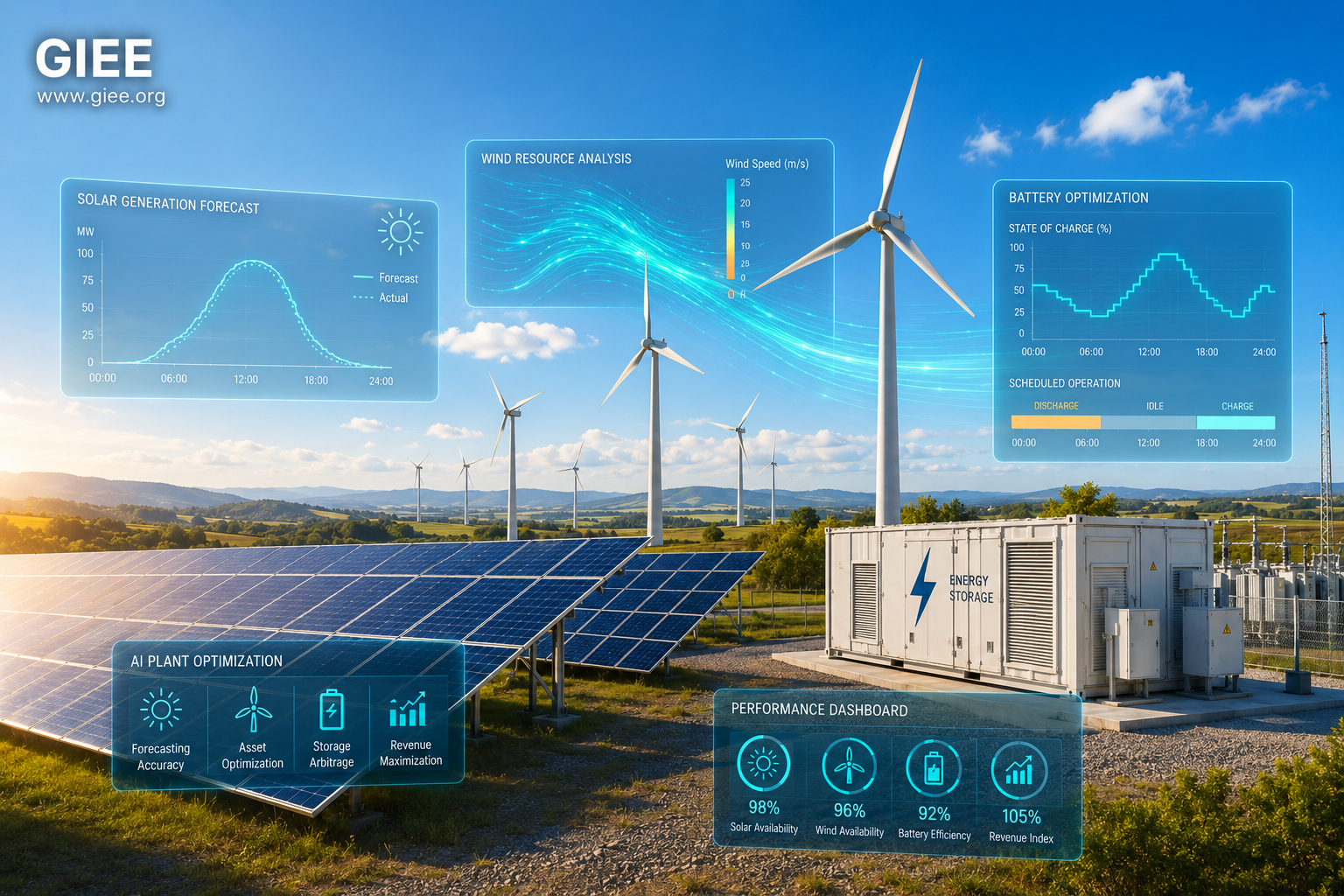
EE421 is the second course in GIEE's Energy Add-On track and the operational and optimization companion to EE420's market focus. Where EE420 covers the financial layer of energy markets, EE421 covers the physical layer of renewable energy and storage operations: how AI improves solar and wind forecasting, optimizes plant performance, manages battery storage, and enables high-penetration renewable grid integration.
You will learn how state-of-the-art forecasting combines numerical weather prediction with machine learning to deliver the accuracy improvements that drive billions of dollars of renewable revenue. You will explore hybrid physics-ML models that combine engineering domain knowledge with data-driven techniques to outperform either approach alone. You will master battery storage optimization across operations and asset management. You will examine the AI-driven solutions to high-renewable grid integration challenges that traditional methods cannot adequately address.
Combined with EE420's market focus, EE421 provides comprehensive AI capability for any role across renewable energy and storage development, operations, and asset management. EE421 is required for the CAEP — Certified AI for Energy Professional certification.
What You Will Learn
- Build solar forecasting models using satellite imagery, NWP data, and convolutional neural networks
- Build wind forecasting models that handle non-linear speed-power relationships and wake effects
- Architect hybrid physics-ML models that combine domain knowledge with machine learning
- Optimize battery energy storage operation across multiple revenue streams and operational constraints
- Apply AI to wind plant wake modeling, turbine optimization, and degradation prediction
- Design solar plant performance optimization workflows including soiling and degradation management
- Quantify renewable AI value: curtailment reduction, reserve requirements, market participation revenue
- Address the unique challenges of high-renewable-penetration grids with AI-augmented techniques
Course Structure
EE421 is organized into four modules covering the renewable energy and storage AI landscape:
- Module 1: Solar and Wind Forecasting — State-of-the-art solar forecasting with satellite imagery, NWP data, and CNN architectures. Wind forecasting with non-linear speed-power relationships. Forecast skill metrics and economic value of accuracy improvements.
- Module 2: Hybrid Physics-ML Models — The state of the art for renewable forecasting and asset optimization. Combining numerical weather prediction with machine learning residual modeling. When physics-only versus ML-only versus hybrid approaches each fit best.
- Module 3: Plant Optimization and Asset Management — Solar plant performance optimization including soiling, degradation, and tracker control. Wind plant wake modeling and turbine-level optimization. Predictive maintenance for renewable assets.
- Module 4: BESS Operations and High-Renewable Grid Integration — Battery dispatch, augmentation strategies, end-of-life planning. AI-driven solutions to high-renewable grid integration challenges. Curtailment management and reserve provisioning.
Real-World Examples
Every concept is grounded in real renewable industry deployments. Examine the solar forecasting deployment at a major IPP that reduced day-ahead forecast errors by 32 percent through CNN-based satellite analysis. Review the wind plant wake optimization that increased annual energy production by 4 percent at a 200-megawatt site. Explore the hybrid physics-ML approach used by a national renewable forecasting service for grid operators. Analyze the BESS operational strategy at a portfolio of utility-scale batteries coordinating across energy, capacity, and ancillary service markets. Real plants, real accuracy improvements, real revenue impact.
Who This Course Is For
- Renewable energy developers and IPP professionals
- Renewable energy asset managers and operators
- Solar plant performance engineers
- Wind plant performance and optimization engineers
- Battery storage operations and asset management teams
- Renewable forecasting service providers and analysts
- Grid operations engineers responsible for high-renewable integration
- Anyone pursuing CAEP certification
Prerequisites
- EE400 — AI and Machine Learning Fundamentals for Energy (required)
- EE401 — Deep Learning, LLMs and Generative AI for Energy (recommended; CNN architectures support the solar forecasting module)
- EE405 — AI Across the Energy Value Chain (helpful for strategic context)
- Engineering or technical background in renewable energy, power systems, or related field
- Working knowledge of solar PV or wind energy is helpful but not required
Format and Access
- Duration: Approximately 10 hours of content
- Format: Self-paced online with video instruction, demonstrations, and quizzes
- Course Access: 6 months of full access from enrollment
- Completion Window: 90 days to complete coursework and the final exam
- Assessment: 4 module quizzes (30% of grade) + comprehensive final exam (70% of grade)
- Passing Score: 70% overall
- Language: English
- AI Tools: Encouraged for learning and exercises; prohibited during quizzes and the final exam
Path to Certification
EE421 is the second of three Energy Add-On courses and a required course for CAEP certification:
- CAEP — Certified AI for Energy Professional: Complete the 9 Core courses (EE400 through EE408) plus the 3 Energy Add-On courses (EE420, EE421, EE422), then pass the CAEP certification exam. Total of 12 courses for the credential most valued by renewable developers, market analysts, energy traders, and broader energy professionals.