
Key Takeaways
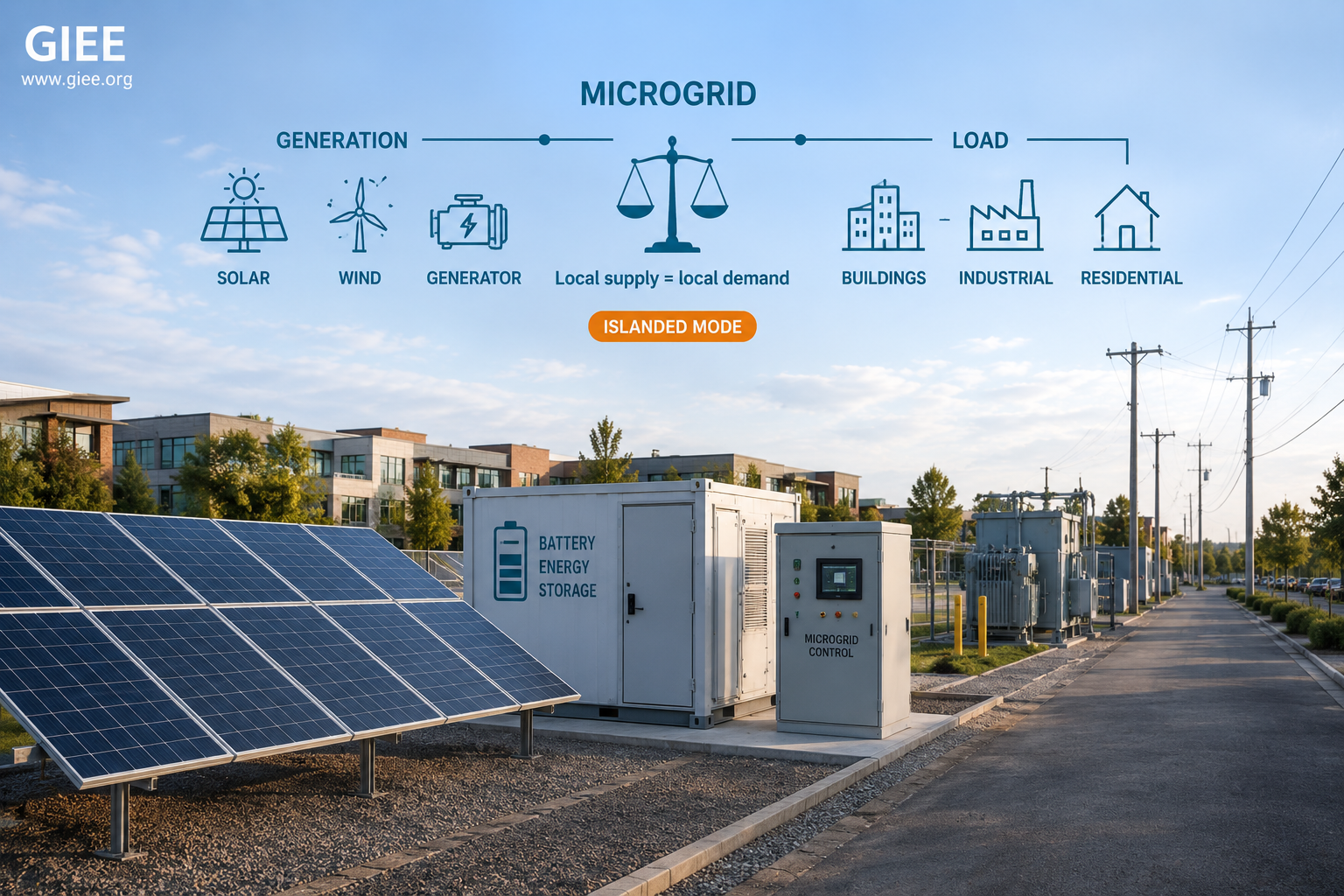
- A microgrid is a bounded set of distributed energy resources (DER) and loads that can run connected to the grid or as a self-sufficient island.
- The defining capability is controlled islanding: opening at the point of common coupling (PCC) and continuing to serve local load.
- Islanded operation needs at least one grid-forming resource to set voltage and frequency. Most inverters are grid-following and cannot run without an external reference.
- Sizing is driven by the worst-case islanded balance: generation, storage energy, and critical load must reconcile across the entire outage window.
- IEEE 2030.7 defines the microgrid controller functions; IEEE 1547-2018 governs how the DER behave at the PCC.
Microgrids have moved from research demonstrations to a mainstream planning option. Three forces drove the shift: distributed energy resources (DER) became cheap and abundant, extreme-weather outages exposed the fragility of long radial feeders, and lithium-ion storage fell far enough in price to make local energy buffering economic. Utilities, campuses, industrial sites, and remote communities now routinely ask the same question. Can we carve out a section of the network that keeps running when the wider grid does not?
Installed and planned microgrid capacity in the United States is now measured in gigawatts [Wood Mackenzie / DOE; verify latest figure before publishing]. This article answers the underlying engineering question from first principles: what a microgrid actually is, the components it is built from, how power balances inside it, and what changes the instant it disconnects.
A microgrid is a controllable slice of the grid
The most useful definition comes from the US Department of Energy. A microgrid is a group of interconnected loads and distributed energy resources within clearly defined electrical boundaries that acts as a single controllable entity with respect to the grid, and that can connect and disconnect to operate in both grid-connected and island mode [DOE Microgrid Exchange Group]. Three properties in that sentence carry all the engineering weight.
First, there is a defined electrical boundary. A microgrid is not just “some solar and a battery.” It is a specific set of buses, feeders, and connection points that you can draw a line around. Second, it behaves as a single controllable entity: from the utility’s side of the meter, the whole assembly looks like one dispatchable resource that can absorb or inject power on command. Third, and most important, it can island: it can open one switch, the interconnection at its point of common coupling (PCC), which is the single electrical point where the microgrid meets the utility, and keep its own lights on. That same switch recloses to resynchronize the microgrid once the grid returns.
It helps to contrast this with the traditional power system, because a microgrid quietly inverts several assumptions engineers grew up with. The conventional grid is built around large central generators feeding power one direction down radial feeders to passive loads. Big synchronous machines do three jobs at once: they hold voltage and frequency, they supply the kinetic inertia that resists sudden frequency change, and they deliver large fault currents that let overcurrent protection clear faults quickly. Protection schemes assume a single source feeding the fault from upstream.
A microgrid breaks most of those assumptions. Generation is distributed and often interfaced through power electronics rather than spinning mass. Power can flow either direction at the PCC. There may be several sources, not one. And when the microgrid islands, it loses the stabilizing presence of the bulk system entirely. Everything that follows in this article is, in some sense, a consequence of those four changes.
The four building blocks
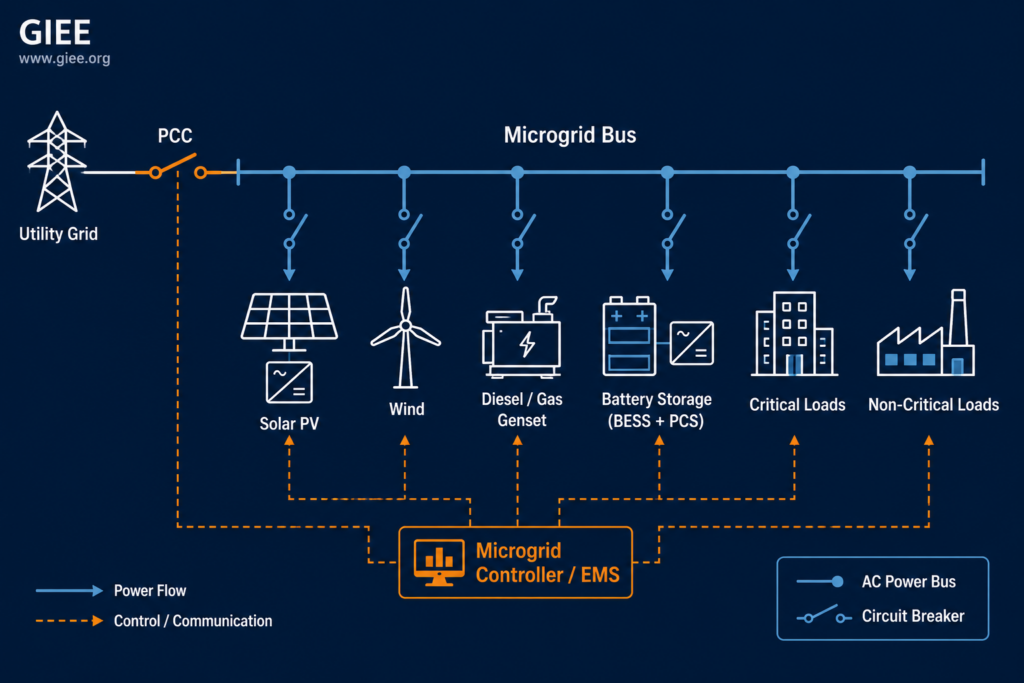
Almost every microgrid, from a 200 kW remote installation to a 20 MW campus, is assembled from the same four functional blocks: generation, storage, loads, and control.
Distributed generation
Generation supplies the energy. The mix is chosen for the site’s resource, fuel access, and resilience target. Solar photovoltaic (PV) is the most common renewable source because it is modular and cheap, but it is non-dispatchable: output follows irradiance, not demand. Wind adds energy where the resource exists but brings its own variability. For firm, dispatchable capacity, microgrids still lean heavily on engine generators, typically diesel or natural-gas gensets, and increasingly on fuel cells. A genset matters in islanded mode for a reason beyond energy: a synchronous machine can set the island’s voltage and frequency and contribute real fault current, which inverters struggle to do.
Energy storage
Storage, almost always a lithium-ion battery energy storage system (BESS) interfaced through a power conversion system (PCS), is what turns a collection of variable sources into something that behaves like a power plant. It does three distinct jobs. On a sub-second to second timescale it absorbs the mismatch between generation and load, smoothing the fast transients that would otherwise move frequency. On a minutes-to-hours timescale it shifts energy from when it is generated to when it is needed. And during the transition into an island it bridges the gap while slower generators start and synchronize. Sizing therefore has two independent dimensions: power rating in MW (how fast it can absorb or deliver) and energy rating in MWh (how long it can sustain that).
Loads
Loads are not all equal, and good microgrid design starts by ranking them. Engineers separate critical loads that must stay energized through an outage (life-safety systems, data centers, process equipment that is expensive to restart) from non-critical or curtailable loads that can be shed to keep the island stable. The ability to drop non-critical load on command is a control resource in its own right. It is often cheaper to shed 300 kW of comfort cooling for an hour than to oversize a battery to carry it.
Control
The microgrid controller, or energy management system (EMS), is the brain that makes the other three blocks act as the “single controllable entity” in the definition. It performs economic dispatch in grid-connected mode, detects grid disturbances and commands the island transition, manages frequency and voltage once islanded, sheds and restores load, and resynchronizes to the grid when it returns. IEEE 2030.7 specifies these microgrid controller functions, and IEEE 2030.8 covers how to test them. Without this layer, the hardware is just DER on a feeder, not a microgrid.
How power balances inside a microgrid
An electrical network has no meaningful storage of its own. At every instant, the power injected must equal the power consumed, plus losses. In a microgrid the bookkeeping is explicit because every term is something an engineer controls.
In grid-connected mode, the utility is effectively an infinite bus. It holds voltage and frequency, and the P_grid term floats freely to close any gap the local resources do not. The controller is then free to optimize for economics rather than survival: charge the battery when energy is cheap, discharge into expensive peaks, soak up surplus PV, and export when it pays. Consider a campus at midday drawing 3.2 MW with PV producing 1.8 MW and the battery idle. The balance closes through the grid: P_grid = 3.2 – 1.8 = 1.4 MW imported. Nothing dramatic happens because the grid silently absorbs whatever is left over.
In islanded mode, the PCC opens and P_grid goes to zero. The same equation now has no free term. Local generation plus net battery output must equal load and losses at every instant, with no help from outside. That single change reshapes the control problem, because some resource inside the boundary must now take over the jobs the grid used to do: holding voltage and frequency, and supplying the first burst of power the moment the grid disappears.
This is where the distinction between grid-following and grid-forming matters. A grid-following inverter, the default for most PV and many batteries, behaves as a current source. It measures the grid’s voltage and frequency and injects power synchronized to that reference. Remove the reference and it has nothing to follow, so it trips. A grid-forming resource behaves as a voltage source: it imposes the voltage waveform and frequency itself, and the others lock onto it. In an island you need at least one grid-forming device, whether a synchronous genset or a grid-forming BESS, or the island simply collapses.
⚠️ Common Mistake: assuming a microgrid full of solar and grid-following batteries can ride through a grid outage. Without a grid-forming source to establish voltage and frequency, those inverters lose their reference and shut down within cycles. The island fails not for lack of energy but for lack of a reference.
Once islanded, frequency control is shared through droop. Each grid-forming source lowers its frequency slightly as it picks up more power, exactly as a synchronous machine governor does. The relationship is linear.
Droop has a useful consequence: if two grid-forming units share the same per-unit droop, they split load in proportion to their ratings automatically, with no communication. Take a 1.5 MW unit and a 0.75 MW unit, both set to 5% droop, carrying an island load of 1.8 MW. They share it as 1.2 MW and 0.6 MW, each at 80% of its rating. Primary droop alone would let frequency sag with loading; the microgrid controller’s secondary loop then nudges the setpoints to trim frequency back to 60 Hz, the local equivalent of automatic generation control. The deeper challenge is that inverters carry no inherent inertia. With little kinetic mass in a small island, the rate of change of frequency after a disturbance is fast, which is why grid-forming inverters increasingly emulate synthetic inertia to keep transients manageable.
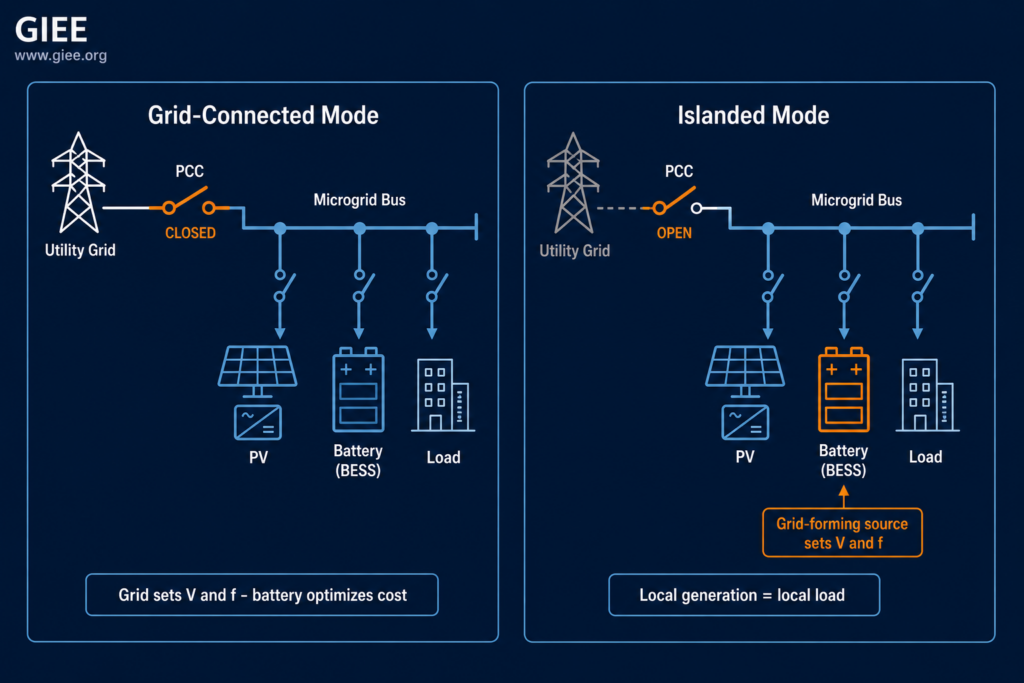
The two modes differ in almost every operational respect, which the table below summarizes.
| Aspect | Grid-connected mode | Islanded mode |
|---|---|---|
| Voltage / frequency reference | Set by the utility | Set by a grid-forming source inside the microgrid |
| Power balance term that floats | Grid import / export (P_grid) | Storage and dispatchable generation |
| Control objective | Economics: cost, peak shaving, export revenue | Survival: stability and critical-load continuity |
| Fault current available | High (utility behind PCC) | Low if inverter-dominated; protection must be re-evaluated |
| Inertia | Provided by the bulk system | Limited; may require synthetic inertia |
Putting numbers to it
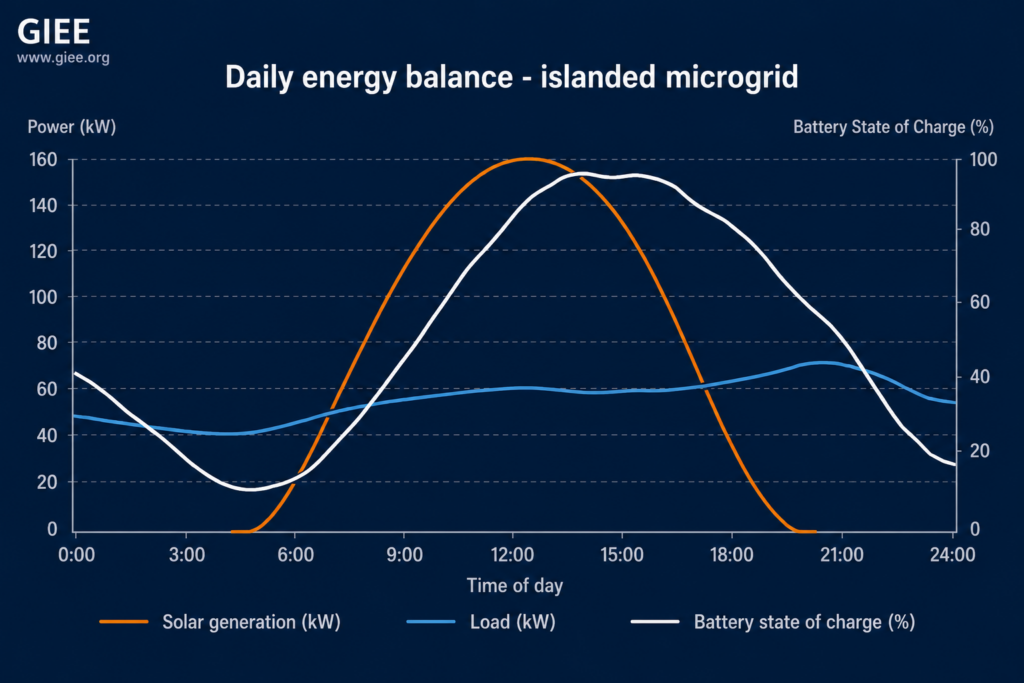
The interesting engineering decisions in a microgrid are sizing decisions, and they are driven by the islanded case, not the everyday one. The single most common is how much energy the battery must hold to carry a site through the period when generation cannot. Consider a remote microgrid on a small island where solar covers the day but there is no grid to lean on at night.
Generation-demand matching during a planned island is the other revealing calculation, and it lives on a much faster timescale. Picture the campus from earlier islanding at midday, the instant before the grid drops. Load is 3.2 MW, PV is supplying 1.8 MW, and the grid had been covering the remaining 1.4 MW. When the PCC opens, that 1.4 MW gap must be filled within a cycle or two or frequency dives. The battery, with its millisecond response, instantly picks up the 1.4 MW and holds the island steady while the 2 MW genset receives its start command, comes up to speed, synchronizes, and ramps to take over. The battery’s job here is defined by power and speed, not energy: it only needs to bridge the tens of seconds until the genset is carrying the load. This is exactly why a microgrid that is rich in PV still benefits from even a modestly sized fast battery. The dispatch, transition, and resynchronization logic behind all of this is precisely what IEEE Std 2030.7-2017 specifies for the microgrid controller, while IEEE Std 1547-2018 governs how the DER themselves interconnect and ride through disturbances at the PCC.
Where microgrids actually get built
The four blocks combine differently depending on what the site is trying to achieve, and four archetypes cover most real deployments.
A campus microgrid at a university, hospital, or military base usually exists for resilience. It might pair a few MW of rooftop and carport PV with a battery and one or two gas gensets, sized so that critical buildings stay lit through a multi-day grid outage. The economic case is partly avoided downtime and partly demand-charge management during normal operation. The well-documented Santa Rita Jail and various university campus systems follow this pattern, and the design tension is always the same: how many hours of full islanded autonomy justify how much capital.
An industrial facility microgrid is driven by process continuity. For a semiconductor fab or a chemical plant, a voltage sag of a few cycles can scrap a production run worth far more than the microgrid itself. Here the storage and grid-forming capability matter more than renewable content, because the goal is power quality and ride-through, not clean energy. The battery’s power rating, fast response, and seamless-transfer capability dominate the specification.
A remote or island microgrid often has no grid to connect to at all and runs in permanent island mode. Historically these ran on diesel alone. Adding PV and storage offsets fuel: a well-designed solar-plus-storage retrofit can cut diesel consumption substantially while the gensets remain for firm capacity and grid-forming duty. The sizing example earlier is exactly this case, and the economics hinge on displaced fuel cost, which is why high-fuel-cost islands adopted this model first.
Finally, microgrids are increasingly a tool for renewable integration on the wider distribution system. By bundling PV, storage, and controllable load behind a single controllable PCC, a microgrid can firm variable output, reduce curtailment by time-shifting surplus generation, and present the utility with a predictable, dispatchable resource instead of an unpredictable injection. The microgrid controller turns “uncontrollable DER on my feeder” into “one resource I can schedule.”
The trade-offs engineers should not gloss over
Microgrids solve real problems, but they introduce others that are easy to underestimate. The sharpest is protection coordination. A synchronous source feeds a fault with roughly 4 to 6 times rated current, sometimes more, which is what lets conventional overcurrent relays sense and clear faults. An inverter typically limits its fault contribution to around 1.1 to 1.5 times rated current to protect its semiconductors. In an islanded, inverter-dominated microgrid, the fault current may barely exceed normal load current, and protection schemes designed for the grid-connected world simply will not pick up. This usually forces a rethink toward directional, differential, or communication-assisted protection.
Beyond protection, the control system is the hardest part to get right: detecting islanding conditions, transferring without a visible interruption to critical load, maintaining stability with little inertia, and resynchronizing to the grid only when voltage, phase, and frequency are matched. The economics are not automatic either. A microgrid is a capital-intensive asset whose value is partly the avoided cost of outages, which is genuine but hard to monetize. And interconnection sits inside a regulatory framework, IEEE 1547 and local utility rules, that was largely written for simpler DER, so intentional islanding requires explicit agreements rather than being a default capability.
💡 Practitioner Tip: size the microgrid against the worst-case islanded balance, not the average day. Define your critical load and target autonomy first, then let those two numbers drive storage energy, dispatchable capacity, and the grid-forming requirement. The grid-connected economics follow from a design that already survives the island.
Conclusion
A microgrid is best understood not as a pile of solar panels and batteries but as a controllable boundary: a defined slice of the network that can stand alone when it has to. Everything technical about it follows from one capability, controlled islanding, and from the fact that once the grid is gone, something inside must do the grid’s old jobs of holding voltage and frequency, supplying the first surge of power, and balancing generation against load at every instant. Get the grid-forming resource, the storage sizing, and the protection scheme right, and the rest is optimization. Get them wrong, and the island fails in the first cycle. For engineers, that is the single takeaway: design the island first, and let the everyday economics fall out of a system that already knows how to survive on its own.