
Key Takeaways
- A microgrid is a bounded set of loads and distributed energy resources (DER) within defined electrical boundaries that behaves as a single controllable entity toward the grid, and can run either grid-connected or islanded.
- Its defining capability is the controlled transition between those two modes. In a low-inertia, inverter-dominated microgrid that depends on grid-forming control to establish voltage and frequency from a current-limited source.
- Microgrid control is hierarchical: primary (droop) holds stability in milliseconds, secondary restores nominal voltage and frequency, and tertiary handles economic dispatch and the grid interface.
- Protection, not generation, is the hard engineering problem. Islanded fault current from inverters is often only 1.1–2× rated, so relay settings that work grid-connected may fail to detect faults when islanded, forcing adaptive or communication-assisted protection.
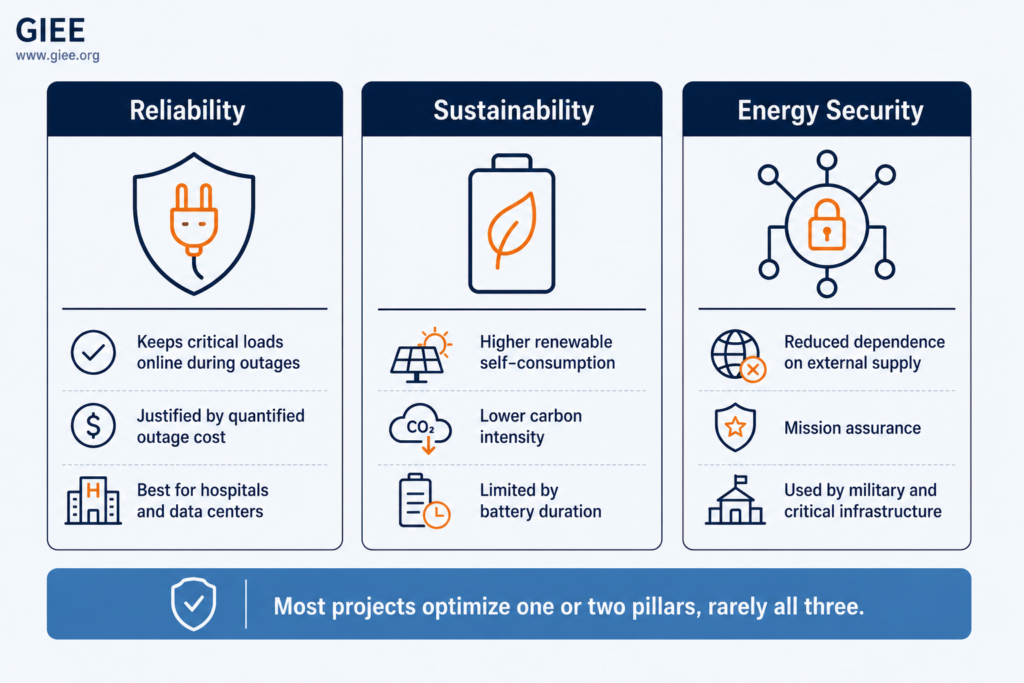
- Reliability, sustainability, and energy security are distinct value streams that trade off against one another. Most projects optimize one or two, rarely all three equally.
Why Microgrids Are Getting Serious Attention
Extreme-weather outages, grid-hardening mandates, and the falling cost of solar-plus-storage have moved microgrids from demonstration projects to line items in utility and facility capital plans. After multi-day outages tied to winter storms, hurricanes, and wildfire-driven public safety power shutoffs (PSPS), hospitals, data centers, military installations, and municipalities are asking a sharper version of an old question: can this site keep its critical loads energized when the bulk power system cannot, and for how long?
Two developments made that question answerable at a defensible cost. Inverter and battery prices fell far enough that on-site solar and storage now compete with diesel across many duty cycles, and microgrid controls matured to the point of standardization. IEEE Std 2030.7-2017 defines what a microgrid controller must do, and IEEE Std 2030.8 defines how to test one. The controllable, multi-resource system that used to be a research topic is now a procurable product with a conformance pathway.
This article is written for engineers who have to evaluate or design that system. We define precisely what a microgrid is, work through the control and protection mechanisms that let it island and reconnect cleanly, and separate the three benefits – reliability, sustainability, and energy security – that justify most deployments. The emphasis throughout is on where each claim holds up and where it is oversold.
What a Microgrid Actually Is
A microgrid is a group of interconnected loads and distributed energy resources within clearly defined electrical boundaries that acts as a single controllable entity with respect to the grid, and that can both connect to and disconnect from the grid to operate in grid-connected and island modes. That definition, in substance, comes from the U.S. Department of Energy and has become the working standard for the industry. [CITE: DOE microgrid definition]
The phrase that does the real work is single controllable entity. From the area grid’s perspective, a microgrid is not a scatter of independent inverters and meters – it is one dispatchable, schedulable resource that can be told to import, export, hold a setpoint, or disconnect. That abstraction is what lets a distribution operator treat it as a known quantity in planning and operations rather than an unpredictable cluster of DER.
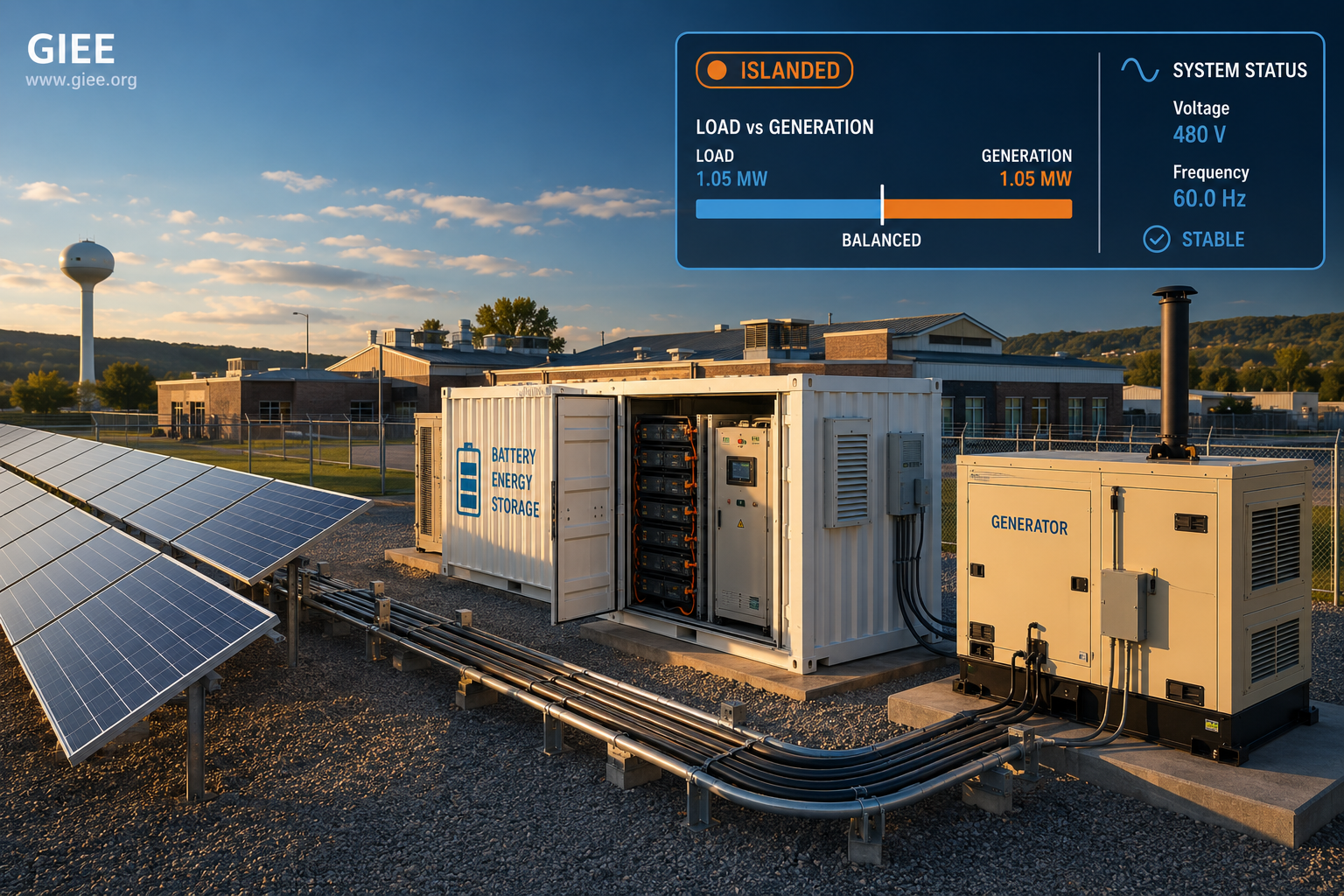
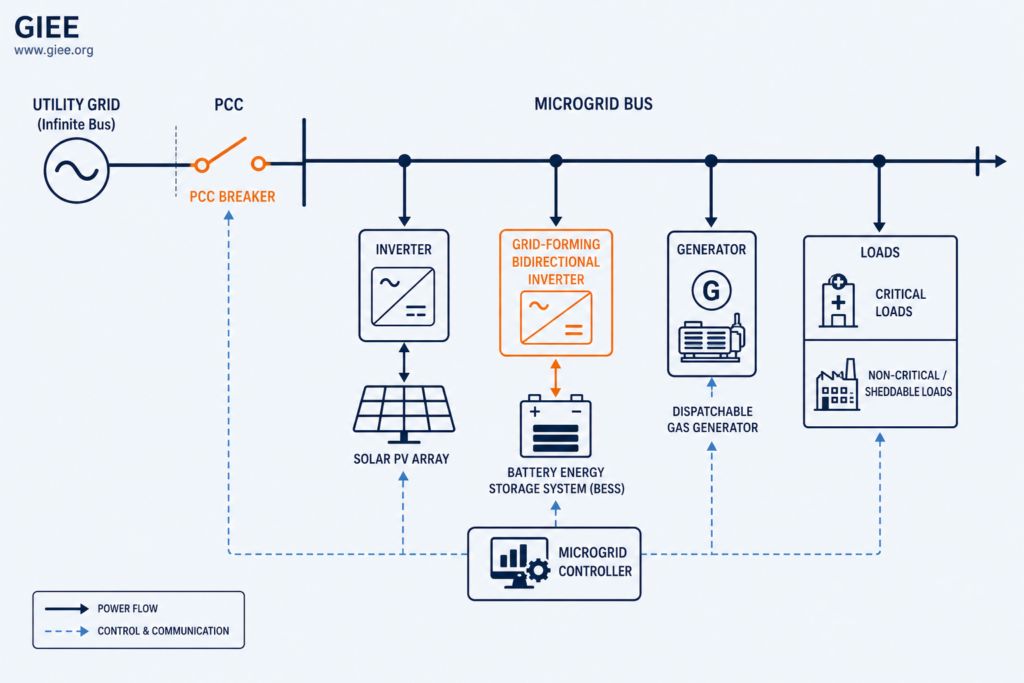
Three features separate a microgrid from a building with a backup generator or a site with rooftop solar. First, it has defined electrical boundaries: a single point of common coupling (PCC) where it connects to the area electric power system. Second, it contains its own generation and usually storage – commonly a mix of solar PV, a battery energy storage system (BESS), and a dispatchable resource such as a gas generator or fuel cell. Third, it can island: open at the PCC, keep its internal loads served on its own resources, and then resynchronize and reconnect when the grid returns. A standby generator does neither of the first two and only crudely does the third. The microgrid’s intelligence – coordinating multiple resources to balance generation and load in real time, with or without the grid behind it – is the actual product.
Definition – islanding: the intentional, controlled operation of a microgrid as an electrically isolated system, disconnected from the area grid at the point of common coupling, with the microgrid’s own resources maintaining voltage and frequency. This is distinct from unintentional islanding, which interconnection standards such as IEEE 1547 explicitly require DER to detect and avoid.
How Microgrids Work
Grid-connected mode: the easy case
While the PCC is closed, the surrounding grid behaves as a stiff voltage and frequency source. The microgrid’s resources simply inject or absorb power against that reference, the same way any grid-following inverter-based resource (IBR) does: a phase-locked loop (PLL) tracks the measured grid voltage, and the converter is controlled as a current source that delivers a commanded amount of active and reactive power. Frequency and voltage regulation are someone else’s job – the bulk power system’s – so coordination is straightforward.
Islanded mode: where the engineering lives
The moment the PCC opens, that external reference disappears. Nothing outside the boundary now holds frequency at 60 Hz or regulates voltage, so something inside has to take over as the grid-forming reference. Historically that role fell to a synchronous generator, whose rotating mass provides physical inertia and whose governor naturally arrests frequency excursions. Increasingly it falls to a grid-forming inverter: a converter controlled to behave as a voltage source that imposes a voltage waveform of defined magnitude and frequency, and lets the network draw whatever current it needs, rather than following an external voltage. This distinction is the single most important control concept in modern microgrids, and it is summarized below.
| Attribute | Grid-following (GFL) | Grid-forming (GFM) |
|---|---|---|
| Behaves as | A current source that injects commanded power | A voltage source that sets voltage and frequency |
| Needs an external reference? | Yes – locks onto a stiff grid voltage via a PLL | No – establishes its own voltage and frequency |
| Can sustain an island alone? | No | Yes – can form and hold the island |
| Inertia / fast response | None inherent | Can provide synthetic inertia and fast frequency response |
| Typical role | Most existing PV and wind inverters | The BESS or a designated grid-forming unit |
The reason grid-forming control matters so much in island mode is inertia, or the lack of it. A power system’s ability to resist sudden frequency change is governed by its inertia constant: the rate of change of frequency after a power imbalance is inversely proportional to the system inertia, so a small inverter-dominated island with little or no rotating mass sees very fast frequency swings (high RoCoF) when a load steps or a resource trips. Grid-forming inverters counter this by responding within milliseconds and, in advanced controls, by emulating inertia. This is what makes a high-renewable, low-inertia microgrid stable when it stands on its own.
Hierarchical control and the microgrid controller
Coordinating all of this is the microgrid controller, the real-time supervisory system specified in IEEE Std 2030.7. Control is conventionally organized in three layers operating on different time scales. Primary control acts locally in milliseconds to stabilize voltage and frequency, most often through droop control, which lets multiple sources share load without communicating with one another. Secondary control acts in seconds to restore frequency and voltage to their nominal values after the droop response has settled. Tertiary control acts in minutes and handles economic dispatch, state-of-charge management, and the power exchange with the grid at the PCC.
The controller also manages the events at the boundaries of operation. A well-designed controller transitions to island mode in a fraction of a second – fast enough that sensitive loads never see an interruption (a seamless, or make-before-break, transition), as opposed to the multi-second gap of a conventional transfer switch. It performs black start when an islanded microgrid has to energize itself from a fully de-energized state, sequencing the grid-forming source up first and then bringing on load and additional resources. And it handles resynchronization: before reclosing the PCC, a synchronizing check confirms that the microgrid’s voltage magnitude, phase angle, and frequency are within tolerance of the returning grid, so reconnection does not produce a damaging transient.
⚠️ Common Mistake: treating a microgrid as a generation-sizing problem. The resources are usually the straightforward part. Protection coordination and the controller’s transition logic are where projects fail. Fault current in island mode, dominated by current-limited inverters, can be a small fraction of the grid-connected level, so overcurrent relay settings that work when connected may never detect a fault when islanded.
The Three Value Pillars
Microgrids are sold on three benefits. They are genuinely distinct, they trade off against one another, and almost no project maximizes all three at once. Identifying which one your stakeholder actually wants is the first design decision, because it sets the sizing, the resource mix, and the budget.
Reliability
This is the most established value stream and usually the easiest to justify. A microgrid keeps critical loads energized through grid outages by islanding. The relevant metric is not average reliability indices such as SAIDI or SAIFI, but the cost and consequence of a specific multi-hour or multi-day outage, which for industrial and critical facilities can run to hundreds of thousands of dollars per event. [STAT: cost of interruption per critical-facility outage event, source – LBNL ICE Calculator] The reliability case is strongest where outage consequences are severe and the local grid has a poor record. It is weakest where utility supply is already highly reliable and a code-compliant standby generator would meet the actual requirement at far lower cost.
A useful discipline here is to quantify the value of avoided outages before sizing anything. Running a site’s load profile through an interruption-cost framework such as the LBNL Interruption Cost Estimate (ICE) calculator turns the resilience benefit into a number rather than an adjective, and that number sets the budget the microgrid has to fit inside.
Sustainability
A microgrid can lower carbon intensity and raise on-site renewable utilization, but only by design, not by default. Pairing solar PV with storage lets a site self-consume more of its own generation, ride through cloud transients, and lean less on grid power during high-emission hours. Some microgrids are built explicitly to hit a renewable-energy or decarbonization target.
The honest caveat: many resilience-driven microgrids still include a fossil generator for long-duration islanding, because today’s battery durations – commonly 2–4 hours for lithium-ion BESS – cannot cover a multi-day outage economically. Sustainability and worst-case resilience pull in opposite directions here. Long-duration energy storage (LDES) and hydrogen-fueled resources may eventually close that gap, but in 2026 most all-renewable microgrids are sized for hours of autonomy, not days.
Energy Security
Energy security overlaps with reliability but is distinct: it is about reducing dependence on external supply and exposure to disruption – fuel supply chains, market price volatility, or deliberate attack on grid infrastructure. For military bases (the U.S. Department of Defense has been a leading microgrid adopter for exactly this reason) and for critical infrastructure operators, the question is mission assurance: can the site complete its function if the surrounding grid is degraded or contested?
A microgrid with on-site generation, storage, and the ability to island indefinitely given fuel provides that assurance. The trade-off is cost and complexity. Security-grade microgrids often carry redundant resources and harder cybersecurity requirements, because the controller and its operational-technology (OT) communications become a protected attack surface – governed by frameworks such as the NERC CIP series for bulk-system-connected assets and IEC 62443 for industrial control systems.
Limitations and Trade-Offs
Microgrids are not a default solution. Four constraints recur across projects, and they are where most of the real engineering effort goes.
Protection is the hard problem. Inverter-dominated microgrids produce limited fault current in island mode – often only 1.1–2× rated current, because converters actively limit their output to protect their semiconductors, versus the much higher and stiffer fault levels available when grid-connected. Conventional time-overcurrent protection, which depends on a large fault current to discriminate and operate quickly, may not pick up faults at all. The practical responses are adaptive protection (relay settings groups that switch automatically between grid-connected and islanded modes), communication-assisted schemes, and differential protection, which detects a fault from the imbalance between currents entering and leaving a zone rather than from magnitude alone. This reconfiguration is frequently the most engineering-intensive part of a design and is easy to underestimate.
The controller is a single point of complexity. Coordinating dispatch, mode transitions, load shedding, black start, and resynchronization across heterogeneous resources from multiple vendors is non-trivial, and controller integration and commissioning are a common source of project delay and cost overrun. The IEEE 2030.8 test procedures exist precisely because this layer is hard to get right and harder to verify by inspection.
Economics depend heavily on context. Microgrids pay off where outage costs are high, where extending the grid is expensive (remote or island communities), or where revenue stacking is available – combining resilience value with demand-charge reduction, capacity payments, ancillary services, or energy arbitrage. A microgrid that earns only one of these revenue streams rarely clears its capital cost; one that stacks several can. Absent those conditions, a simpler solution usually wins.
Sustainability and resilience can conflict. As covered above, the cleanest microgrid and the most resilient microgrid are rarely the same design. The cleanest one minimizes fossil capacity; the most resilient one keeps a dispatchable, fuel-secure resource on hand for the long outage. Resolving that tension is a stakeholder decision disguised as an engineering one, and it should be made explicitly rather than by default.
The Bottom Line
A microgrid is best understood as a controllable boundary around loads and resources that can stand on its own when the grid cannot carry it. Its value comes in three forms – reliability, sustainability, and energy security – that engineers should treat as separate objectives with real trade-offs, not a single bundled promise. The generation is rarely the hard part; the control architecture and the protection scheme are. Evaluate a microgrid the way you would evaluate any planning decision: against a quantified problem, and alongside the cheaper alternatives it has to beat.
If you are building the analytical foundation for this kind of work – DER integration, hosting capacity, and distribution planning – see GIEE’s EE400 course on distribution system planning and our related guides on grid integration of DER and grid-forming inverters.