
Key Takeaways
- A normal AI tool answers a question. An AI agent is given a goal and then works toward it on its own, taking actions until the job is done.
- An AI agent is a single autonomous worker. Agentic AI is the broader approach of building AI that acts with real agency, often by combining many agents into a coordinated team.
- Every agent runs a simple loop: look at the situation, decide, act, and check the result, then repeat.
- Agents come in types – task, conversational, tool-using, retrieval-augmented (RAG), autonomous, and learning – and agentic systems differ by how their agents are organized.
- In energy, a single agent might manage one home battery, while an agentic system can coordinate thousands of devices as one virtual power plant.
- Autonomy is a dial, not a switch. The higher the risk, the more a human stays in control – especially for anything that affects the live grid.
Why These Two Terms Matter
If you have used an AI chatbot, you have seen one side of artificial intelligence: you ask, it answers, and the conversation ends. The newer and more powerful idea is AI that does not just talk, but acts. It can be handed a goal and left to figure out the steps, use tools, and get the job done. This is where the terms “AI agent” and “agentic AI” come from.
People often treat the two as interchangeable, but understanding the difference is the foundation for everything that follows – whether you are a practicing engineer, a professional in the energy sector, or a student just getting started. By the end of this article you will know exactly what each term means, how these systems work, how they differ, and where they are already appearing in the world of energy and the power grid.
What Is an AI Agent?
An AI agent is a single AI system that is given a goal and works toward it on its own, taking actions until the goal is reached. The key word is acts. A chatbot produces words. An agent produces outcomes.
A simple comparison helps. Think of the difference between a calculator and an accountant. A calculator gives you a number the moment you press the keys, and then it waits. An accountant is handed a goal – “prepare my tax return” – and from there takes over: gathering documents, working through the steps, filling in the forms, checking the totals, and coming back only when the task is complete. An AI agent behaves much more like the accountant than the calculator.
To work toward a goal, an agent repeats a simple four-step cycle. It looks at its current situation (perceive), decides what to do next (reason), carries out an action, usually by using a tool (act), and then checks what happened (observe). It runs through that cycle again and again until the goal is met. This loop is the engine of every agent. It is what makes the system “agentic”: not one answer, but an ongoing, self-directed effort.
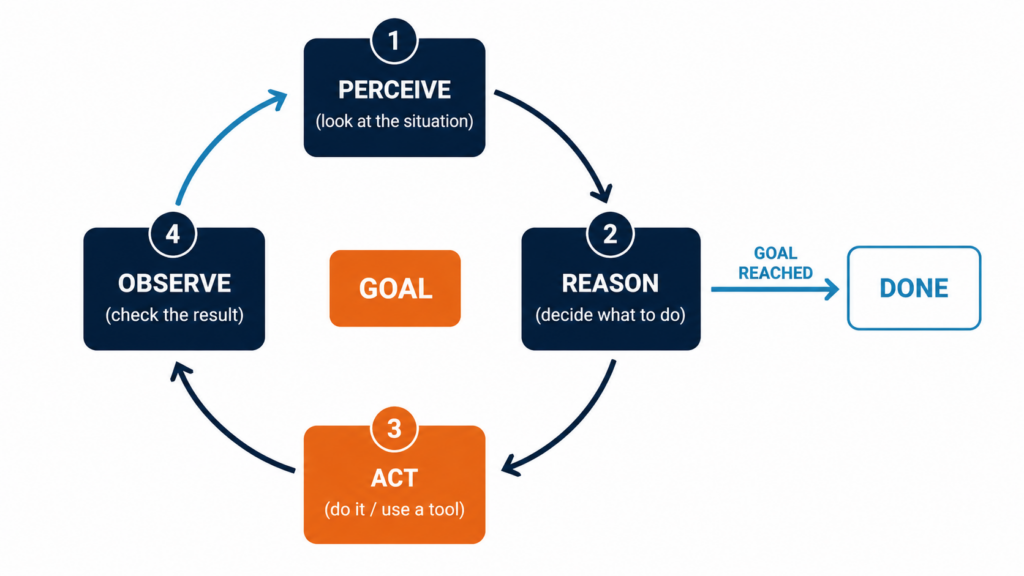
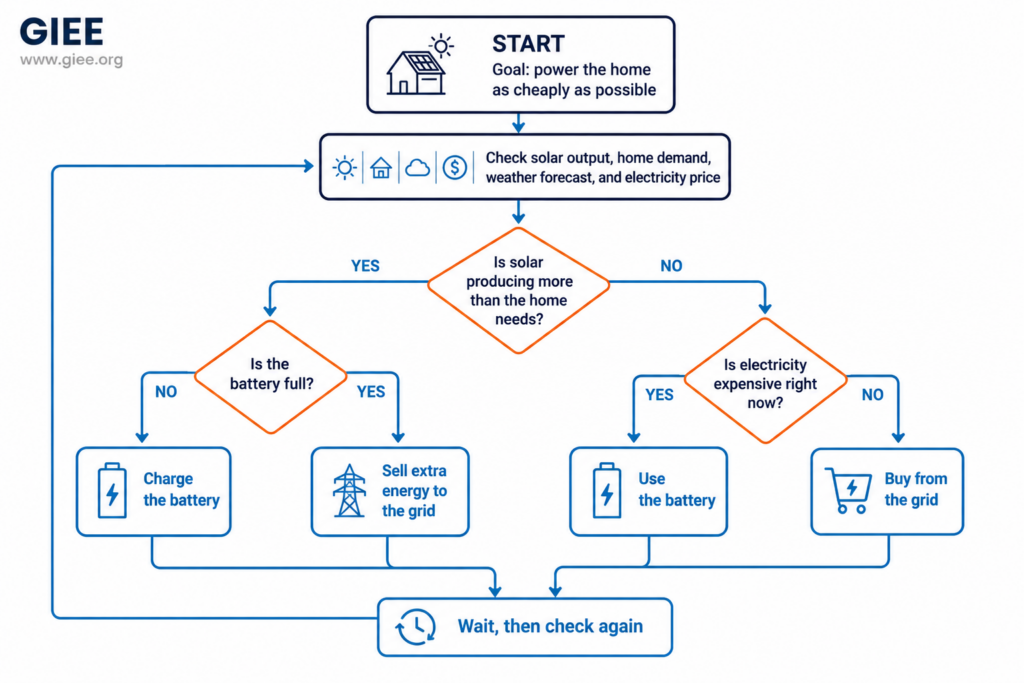
Here is a concrete example from energy. Imagine an AI agent placed in charge of a home that has solar panels and a battery. Its goal is to keep the house powered as cheaply as possible. Throughout the day it watches the weather forecast and the changing price of electricity, decides whether to store solar energy in the battery or use it right away, and acts by charging or discharging the battery as conditions shift. Nobody tells it what to do minute by minute. It simply pursues the goal.
The building blocks of an agent
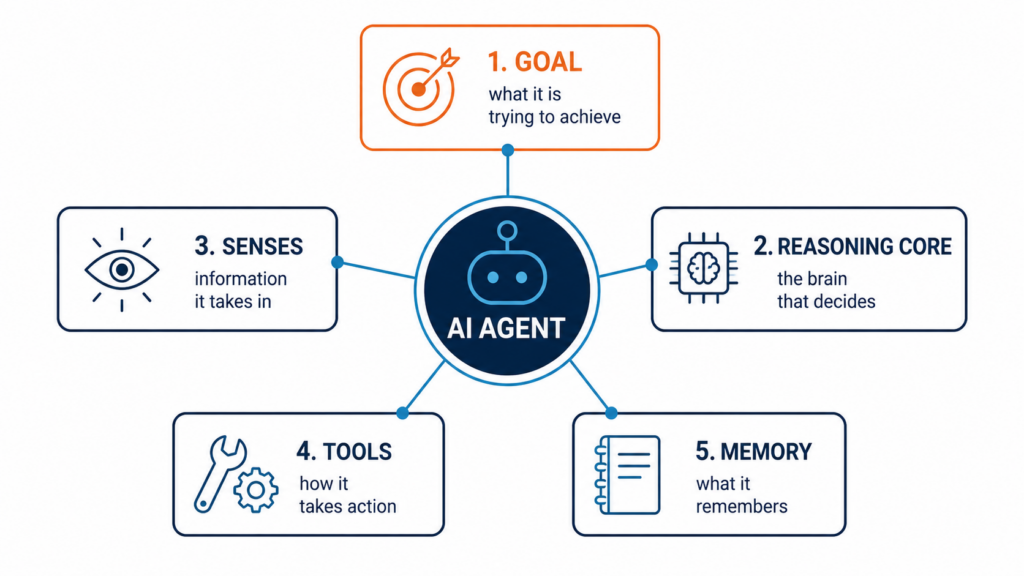
Whether simple or advanced, every agent is assembled from a few parts. It needs a goal to work toward, a reasoning core that acts as its brain and makes decisions, senses that bring in information about the world, tools that let it take action (its “hands”), and memory so it can remember what it has already done. Take any one of these away and the agent stops being useful.
What Is Agentic AI?
If an AI agent is a single capable worker, then agentic AI is the broader idea of building AI that acts with real agency. In practice, that usually means going beyond one agent and combining several agents into a coordinated team that tackles a much larger problem together.
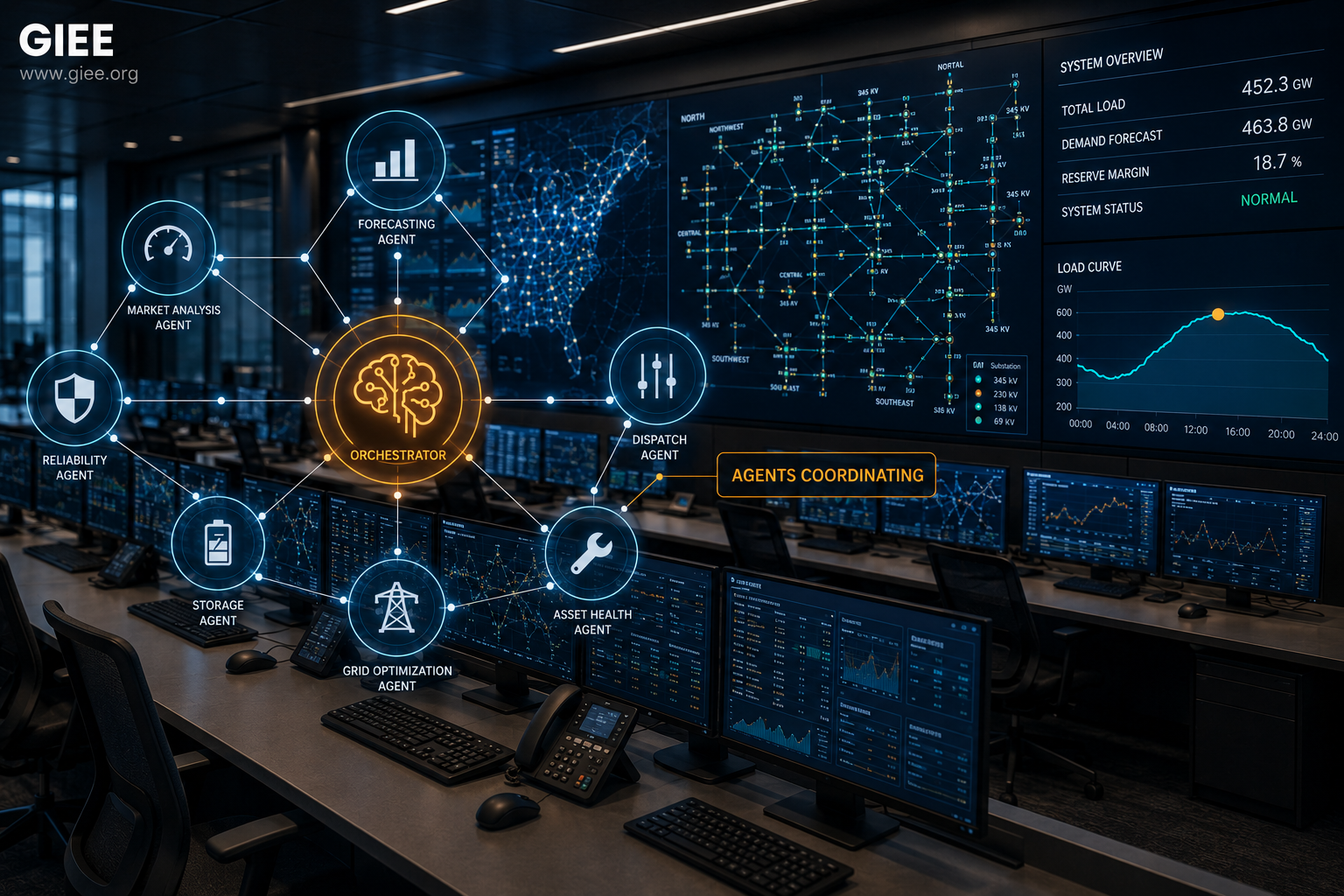
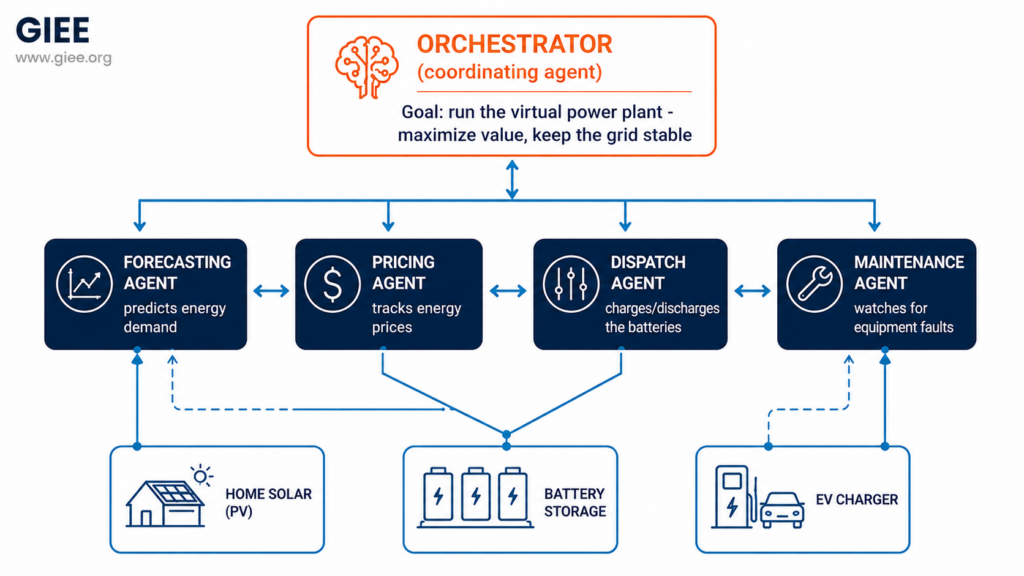
Some goals are simply too big for one worker. Consider running a virtual power plant – a network of thousands of home batteries, solar systems, and smart appliances that are pooled together and operated as if they were a single power station. One agent could not handle all of that well. So agentic AI assigns specialized agents to different jobs: one forecasts how much energy will be needed, another tracks energy prices, another decides how to charge and discharge all the batteries, and another watches for equipment problems. A coordinating agent, often called an orchestrator, keeps them working toward the same shared goal: deliver the most value while keeping the grid stable and safe.
That is the essence of agentic AI: a system of agents that plan, divide the work, collaborate, and adapt toward a complex goal with very little step-by-step human direction. The single agent is the building block. Agentic AI is the larger structure built from those blocks. A useful way to picture it: a single AI agent is one skilled employee, while agentic AI is an entire self-organizing department with a manager keeping everyone aligned.
AI Agents vs Agentic AI: The Core Difference
Definition – in one line: An AI agent is a single autonomous AI worker that pursues a goal. Agentic AI is the broader approach of building AI that acts with agency, usually as a coordinated system of several agents working toward a complex goal.
The simplest way to keep them straight: an AI agent is a thing – one worker. Agentic AI is a way of working – often a whole team. The agent is a noun; agentic is the quality that the agent, or a system of agents, exhibits. The table below lays out the differences across the dimensions that matter most.
| Dimension | AI Agent | Agentic AI |
|---|---|---|
| What it is | A single AI worker (a thing). | An approach or system (a way of working). |
| Scope | One task or well-defined job. | Large, multi-part, changing goals. |
| Made of | One reasoning core, plus tools and memory. | Several agents, plus an orchestrator. |
| Coordination | Works alone. | Agents collaborate and are coordinated. |
| Best for | Clear, bounded tasks. | Complex problems with many moving parts. |
| Everyday picture | One skilled employee. | A whole department with a manager. |
| Energy example | Managing one home battery. | Running an entire virtual power plant. |
One honest note. In everyday conversation people use these terms loosely, and the line between them can blur – a single very capable agent can feel “agentic,” and a small agentic system might use just two agents. That is fine. If you remember that an agent is the worker and agentic AI is the team-and-coordination approach built from such workers, you will read almost any article or product description correctly.
Types of AI Agents
Agents are not all the same. They differ in how they gather information, how much they decide on their own, and what job they are built to do. The categories below are the ones you will meet most often today. They overlap heavily – a single real agent is often several of these at once – so treat them as useful labels rather than rigid boxes.
| Type of agent | In plain terms | Energy example |
|---|---|---|
| Task agent | Built to do one specific, well-defined job from start to finish. | Produces the daily energy-usage report for a building. |
| Conversational agent | Works through back-and-forth dialogue, answering questions and helping you act. | Answers an operator’s questions about what a grid alarm means. |
| Tool-using agent | Can operate other software or equipment to get things done, not just talk. | Runs a grid simulation to test what happens if demand suddenly spikes. |
| RAG agent (retrieval-augmented) | Looks up trusted, up-to-date information before answering, so it is grounded in facts, not memory alone. | Pulls the exact equipment manual and a unit’s repair history before recommending a fix. |
| Autonomous agent | Works over long stretches with little human input, setting its own sub-steps toward a goal. | Manages a home battery all day, adjusting to prices and weather on its own. |
| Learning agent | Improves with experience, getting better as it sees more outcomes. | A demand-forecasting agent that sharpens its predictions each season. |
The one worth a closer look is the RAG agent. RAG stands for retrieval-augmented generation. In plain terms, before the agent answers or acts, it first retrieves relevant information from a trusted library – manuals, records, recent measurements – and uses that to ground its response. This matters in energy work, where being correct depends on the latest readings and the right document, not on whatever a model happened to memorize during training. A RAG agent is far less likely to invent a number, because it checks the source first.
Students may also meet an older, foundational way of grouping agents from classic AI courses: simple reflex agents that react only to the moment, model-based agents that keep an internal picture of the world, goal-based agents that plan toward an objective, utility-based agents that weigh trade-offs to pick the best option, and learning agents that improve over time. That view sorts agents by how much they reason; the modern categories above sort them by how they are built and used. Both are valid lenses on the same technology.
Types of Agentic AI
Once a system has more than one agent, the important question becomes how the agents are organized. That arrangement is what distinguishes one agentic system from another. Four patterns cover most of what you will see, and the diagram below shows their shapes side by side.
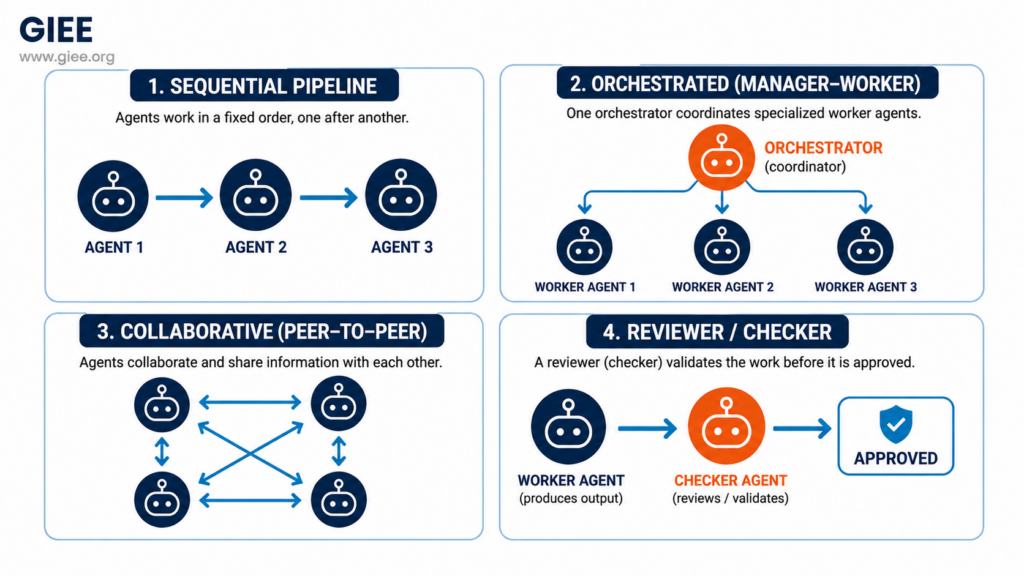
In a sequential pipeline, the agents work in a chain: each finishes its part and passes the result to the next, which suits a job with clear stages. In an orchestrated system – also called manager-worker or hierarchical – a coordinating agent assigns tasks to specialized workers and combines their results, which suits a complex goal with many parallel parts. In a collaborative system, agents coordinate as equals and negotiate among themselves with no single boss, which suits situations where many local decisions interact. In a reviewer setup, one agent does the work and another checks it before anything is acted on, which adds a safety margin when mistakes are costly.
| Pattern | How it is organized | Good for (energy example) |
|---|---|---|
| Sequential pipeline | Agents in a chain; each one’s output feeds the next. | Stage-by-stage jobs – forecast demand, then plan resources, then report. |
| Orchestrated (manager-worker) | A coordinator directs specialized worker agents. | Complex parallel goals – running a virtual power plant. |
| Collaborative (peer-to-peer) | Agents coordinate as equals, with no central boss. | Many local decisions – balancing a neighborhood network. |
| Reviewer / checker | One agent works; another verifies before action. | High-stakes tasks – checking a plan before approval. |
No single pattern is best. The right choice depends on the problem, and many real systems mix them – for example, an orchestrated team that also runs a separate reviewer agent before any action is approved.
Real-World Examples You Already Know
These ideas are not far-off theory. You interact with early versions already, and the energy sector is adopting them quickly. The table below mixes everyday examples with energy and grid examples, and labels each as a single agent or an agentic system.
| Example | Type | What it does |
|---|---|---|
| A self-driving car | AI agent | Pursues one goal – drive safely to a destination – by sensing, deciding, and acting continuously. |
| A travel planner that books your flights, hotel, and car | Agentic AI | Breaks the trip into parts and handles each step, often using several specialized helpers. |
| A home solar-and-battery manager | AI agent | Decides when to store, use, or sell energy to keep one home running cheaply. |
| A virtual power plant coordinator | Agentic AI | Coordinates thousands of batteries and devices to act as one flexible power source. |
| An equipment-health monitor for a substation | AI agent | Watches for early signs of failure, such as a transformer running hot, and raises an alert. |
| A city-wide electric-vehicle (EV) charging optimizer | Agentic AI | Schedules charging across many vehicles and locations to avoid overloading the grid. |
| A control-room assistant for grid operators | AI agent | Groups related alarms and summarizes what is happening so a human can decide faster. |
Notice the pattern. When the goal is single and contained, one agent does the job. When the goal is large, spread out, and made of many interacting decisions, an agentic system – several agents under a coordinator – fits better. To make a single-agent example concrete, the flowchart below traces how a home solar-and-battery agent decides what to do during the day.
Levels of Autonomy: How Much Should We Let Go?
A common mistake is to think of autonomy as on or off. In reality it is a dial. We can let an AI do a little or a lot, and the right setting depends on how much damage a mistake could cause. The table below describes four practical levels with both an everyday picture and an energy example.
| Level | What the AI does | Energy example |
|---|---|---|
| 1. Assistant | Suggests and explains; the human does everything. | Explains to an operator what a grid alarm means. |
| 2. Supervised doer | Does a multi-step task, then waits for a human to approve. | Prepares a plan to connect a new solar site; an engineer approves it. |
| 3. Self-running (within limits) | Runs on its own inside safe boundaries; flags anything unusual. | Manages a home battery all day and alerts a human only if a fault appears. |
| 4. Fully autonomous | Acts without asking, in a narrow, low-risk area. | Best kept to low-risk back-office tasks – not live control of the grid today. |
The guiding rule is simple: the higher the stakes and the faster the decision, the more a human stays in the loop. A monthly planning report can tolerate a lot of autonomy because mistakes are caught and reversed. The split-second protection that shuts down a faulty line, by contrast, must stay precise and human-engineered, because there is no time to undo a wrong move.
Strengths, Limits, and Keeping Humans in Control
The appeal is easy to see. Agents and agentic systems work tirelessly, handle many steps at once, and free people to focus on judgment rather than busywork. In energy, that can mean faster planning studies, smarter use of batteries and solar, and quicker awareness when something goes wrong.
But there are real limits. These systems can be confidently wrong – producing an answer that sounds right but is not. When an agent then acts on a bad conclusion, the error can spread across several steps before anyone notices. They also depend on the data and tools they are given; poor inputs lead to poor actions. And because an agent can take actions, it becomes a new piece of software that must be secured, which matters enormously for anything connected to critical infrastructure like the power grid.
⚠️ Common Mistake: Giving an AI more freedom than the risk justifies. An agent that drafts a report is low risk. The same agent wired to directly control live grid equipment is a safety hazard. Set the level of autonomy by the cost of being wrong – not by what the technology can technically do.
This is why the best designs keep a qualified human at the point where decisions truly matter, and keep a clear record of what the system did and why. For high-stakes, safety-critical work like operating the grid, today’s agents are powerful assistants for planning, monitoring, and analysis – but the final say on actions that affect the live system stays with people. That is not a weakness of the technology. It is good engineering.
Conclusion
Strip away the buzzwords and the picture is clear. An AI agent is a single AI worker that is given a goal and acts to achieve it, looping through perceive, reason, act, and observe. Agentic AI is the larger approach of building AI that acts with agency – most powerfully as a coordinated team of agents solving a complex problem together. The agent is the building block; agentic AI is what you build with it. In energy and the grid, that ranges from one agent managing a home battery to a full system orchestrating a virtual power plant.
The opportunity is real and already arriving, and so is the responsibility that comes with it: match autonomy to the stakes, keep people in control where it counts, and let these systems earn trust on smaller jobs before handing them bigger ones. Master this foundation now and you will be ready for whatever the next wave of these tools brings. To go further, explore our related GIEE explainers on smart grids, energy storage, and how machine learning is reshaping the way we plan and operate the power system.