


This course includes
- About 3 hours of structured instruction
- Self-paced online learning
- 4 modules with video lessons
- 3 module knowledge checks and a final knowledge check
- 70% passing score, unlimited attempts
- Case Data Sheet and downloadable Reference Card
- GIEE Certificate of Completion
- 6 months of course access
Your Certificate
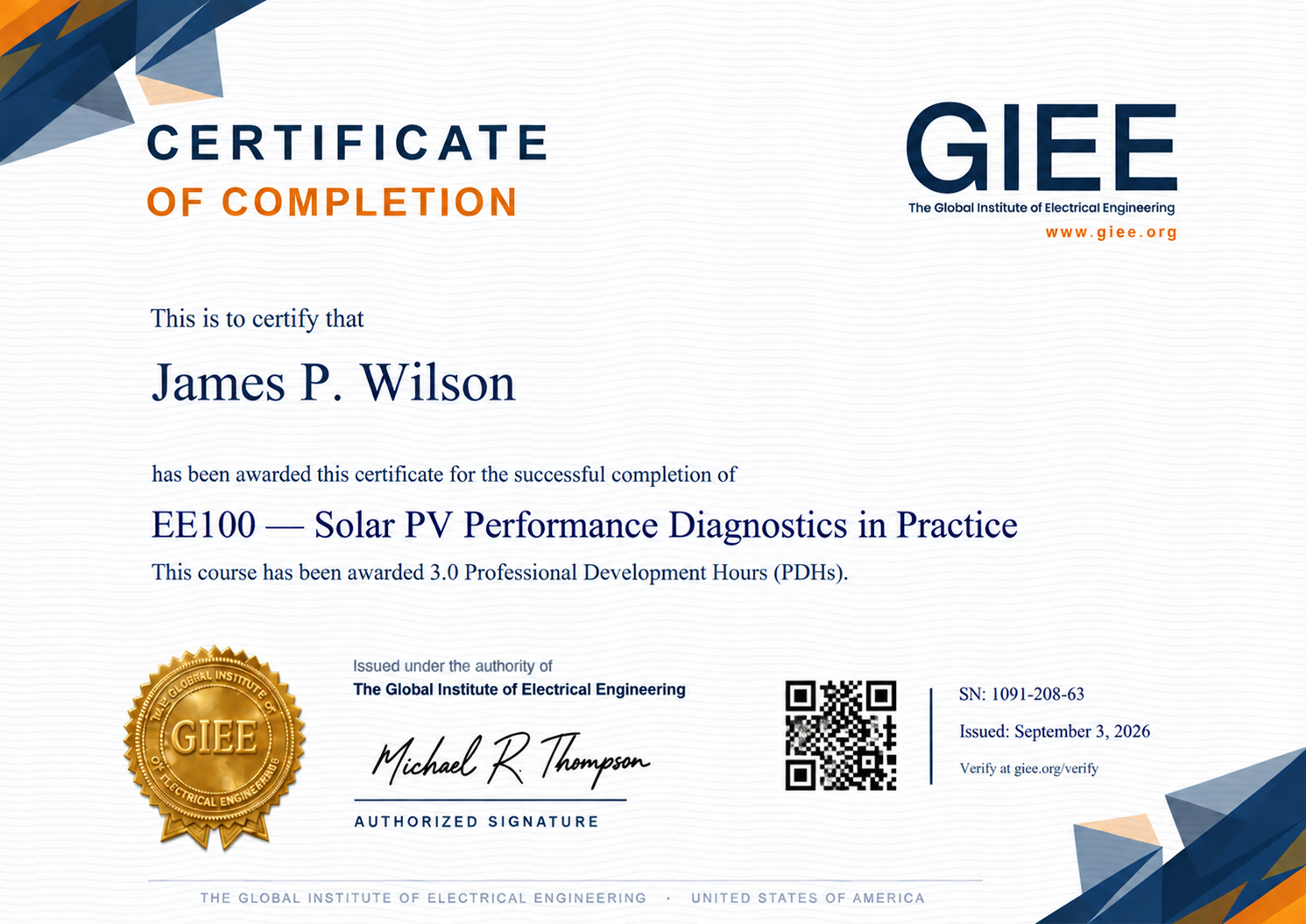
Sample certificate. Every GIEE certificate carries a unique serial number and can be verified at giee.org/verify.
Underperformance is the most common complaint in operational solar, and one of the hardest to resolve, because many different mechanisms produce the same headline symptom: less energy than the model promised. EE100 is a free, standalone GIEE course built around one diagnostic problem: a 100 kWp commercial rooftop system producing 18,000 kWh a year less than expected. You work the case.
The system was expected to produce 142,000 kWh in its first year. It produced 124,000 kWh, a shortfall of 12.7%. EE100 releases the evidence module by module: irradiance, module temperature, shading, soiling, string and MPPT data, inverter records, and an outage log. At every stage you calculate how much of the gap each mechanism explains and decide where to look next. Two of the most likely suspects turn out to explain none of it.
The course closes with a six-question diagnostic workflow and a full worked diagnosis. Only arithmetic, percentages, and ratios are needed, and every coefficient and benchmark is supplied, so the course is open to anyone who works with operating solar systems.
What You Will Learn
- Calculate a performance gap, specific yield, and a simple performance ratio, and judge whether a shortfall is real
- Compare measured against modeled irradiance and quantify how much of a gap the solar resource explains
- Estimate a temperature loss from a supplied coefficient, and recognize a loss that is already in the model
- Normalize string and MPPT data to tell a whole-system loss from a localized fault, and size its impact
- Read inverter DC input, AC output, clipping, and downtime as diagnostic evidence
- Apply a six-question workflow to reach a defensible conclusion and name the next confirming test
Course Structure
EE100 is organized into four modules of short video units, each closing with a knowledge check, plus a final knowledge check.
- Module 1: Is the System Actually Underperforming? Establish the size of the gap with specific yield and a simple performance ratio, and decide whether the shortfall is real and warrants investigation.
- Module 2: Resource and Site Losses: Can They Explain the Gap? Test irradiance, module temperature, shading, and soiling against the evidence, and quantify how much of the gap each one explains.
- Module 3: System and Electrical Losses: Localizing the Problem. Use normalized string and MPPT data and inverter records to separate a whole-system loss from a localized fault, and size its impact.
- Module 4: The Six-Question Workflow and the Full Diagnosis. Bring the evidence together into one defensible conclusion, and take away a workflow and reference card you can apply to your own systems.
Built Around One Real Diagnostic Problem
EE100 is not a survey of loss mechanisms. It is a single worked investigation of a commercial rooftop system, with real operating evidence released in the order a diagnostic engineer would gather it. You do the calculations yourself with the supplied Case Data Sheet, see which explanations the evidence supports and which it rules out, and learn to treat eliminating a suspect as real progress. The result is a repeatable method, not a list of things that can go wrong.
Who This Course Is For
- Solar engineers, designers, and commissioning staff
- Asset managers and operations and maintenance teams
- Developers, analysts, and technical consultants
- System owners and anyone exploring the GIEE catalog
Prerequisites
- None. This course is open to everyone
- Arithmetic, percentages, and ratios only; all coefficients and benchmarks are supplied
- A calculator is useful. No prior GIEE course required
Format and Access
- Duration: About 3 hours of structured instruction
- Format: Self-paced online, with short video units and knowledge checks
- Cost: Free with a GIEE account; no payment details required
- Access: 6 months of full access, with no completion timer, so you can return to the course as a reference
- Module knowledge checks: Formative and ungraded, with unlimited attempts
- Final knowledge check: 15 questions in 20 minutes, open book (4 calculation, 5 diagnostic scenario, 6 concept)
- Passing score: 70%, with unlimited attempts and worked explanations
- Certificate: A certificate of completion, not a professional certification; it does not carry PDH credit
- Language: English
- Open book and AI tools: Both permitted throughout, including during the final knowledge check
Where This Course Leads
EE100 teaches you to diagnose why an operating solar system produces less than expected. Professionals who want to go further into how systems are designed and delivered can continue into the paid pathway.
EE100 also stands entirely on its own. Anyone responsible for an operating solar system gets a practical diagnostic method and reference card from this course alone.