

0
Where Battery Storage Begins EE220 is the entry point of GIEE’s Certified BESS Professional curriculum. This foundational course takes engineers …
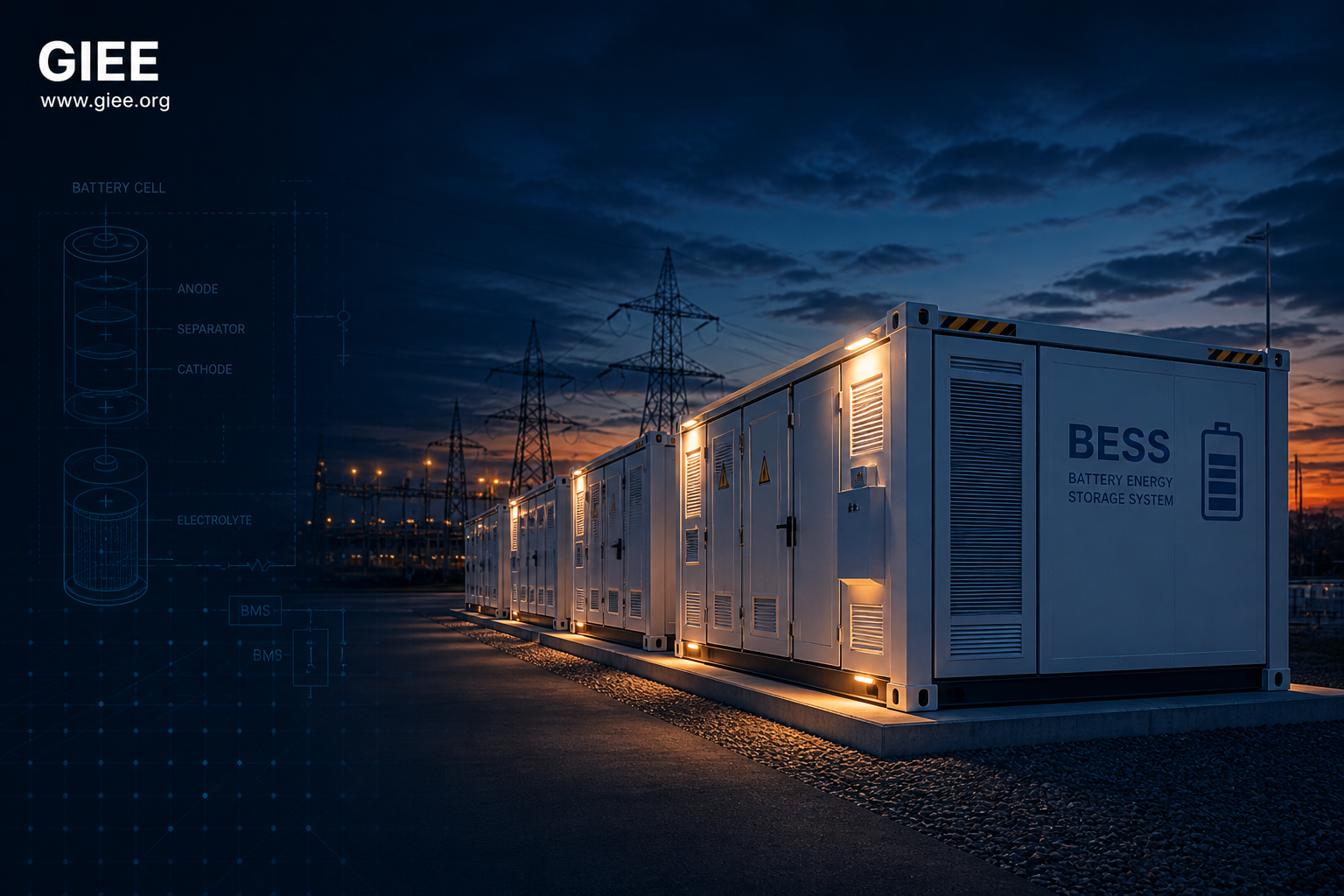
Where Battery Storage Begins
EE220 is the entry point of GIEE's Certified BESS Professional curriculum. This foundational course takes engineers and energy professionals from "I've heard about battery storage" to "I can read a BESS datasheet, command the core metrics, and understand how these systems are built."
Every concept is taught through real deployments and real engineering decisions. You will learn the power-versus-energy distinction through the sizing mistakes that derail real projects. You will learn chemistry selection through the trade-offs that pushed the industry toward LFP for utility-scale storage. You will learn system architecture by building up from a single cell to a containerized megawatt-scale system. The pedagogy is grounded in domain expertise from utility operations and DER planning.
EE220 is required for the CBP (Certified BESS Professional) certification, and is the foundation that makes EE221 (Design and Sizing) and EE222 (Grid Integration, Codes & Operations) possible.
What You Will Learn
- Distinguish power from energy and apply the distinction correctly to BESS sizing and specification conversations
- Read a BESS nameplate and datasheet critically, interpreting capacity, power, C-rate, and efficiency ratings
- Calculate core BESS metrics including capacity, C-rate, energy density, power density, depth of discharge, state of charge, state of health, and round-trip efficiency
- Explain how a lithium-ion cell works at a basic chemistry level: anode, cathode, electrolyte, and separator
- Distinguish NMC, LFP, NCA, and LTO chemistries by energy density, safety, cycle life, cost, and best-fit application
- Recognize emerging chemistries (sodium-ion, flow batteries, solid-state) and their potential roles
- Map BESS architecture from cell to module to rack to system, including the role of the BMS, PCS, and EMS
- Distinguish DC-coupled and AC-coupled architectures at the conceptual level
- Recognize the landscape of BESS applications across residential, C&I, and utility-scale settings, and explain the concept of value stacking
Course Structure
EE220 is organized into five modules, plus a comprehensive final exam:
- Module 1: Foundational Electrical Concepts for BESS — The single most important module. Power versus energy, the units that measure each (Ah, Wh, kWh, MWh), and the core metrics every BESS engineer needs: C-rate, energy density, power density, depth of discharge, state of charge, state of health, and round-trip efficiency.
- Module 2: Introduction to BESS — What a battery energy storage system is, why storage has grown so fast, the high-level architecture, and the landmark deployments that shaped the industry.
- Module 3: Battery Chemistry — How a lithium-ion cell works, the major chemistries (NMC, LFP, NCA, LTO), emerging alternatives, and a structured framework for matching chemistry to application.
- Module 4: BESS System Architecture — How cells scale into complete systems, what the BMS does, how thermal management works, and an orientation to the PCS and EMS.
- Module 5: BESS Applications Taxonomy — An organized map of what BESS is used for across residential, C&I, and utility-scale settings, including the concept of value stacking. Detailed design is covered in EE221; codes and compliance in EE222.
Real-World Examples
Every lesson is anchored in real deployments from leading developers and operators including Tesla, Fluence, AES, Wärtsilä, LS Energy Solutions, and Powin Energy, and landmark projects such as Hornsdale Power Reserve and Moss Landing. You will see actual datasheet figures, real chemistry comparisons, and the engineering decisions behind real systems. No generic "batteries in business" examples; every case study is grounded in energy storage.
Who This Course Is For
- Practicing engineers and energy professionals entering the storage field
- DER planning engineers and grid professionals
- Project developers, analysts, and consultants moving into the storage market
- Recent engineering graduates building expertise for storage roles
- Engineering managers and leads evaluating BESS projects and vendors
- Anyone pursuing CBP certification
Prerequisites
- Technical or engineering background helpful (any discipline)
- Basic electrical concepts: AC/DC, voltage, current
- Familiarity with power systems helpful, not required
- No prior BESS knowledge required
Format and Access
- Duration: Approximately 12-13 hours of content
- Format: Self-paced online with video instruction, embedded worked examples, and quizzes
- Course Access: 6 months of full access from enrollment
- Completion Window: 90 days to complete coursework and the final exam
- Assessment: 5 module quizzes (30% of grade) + comprehensive final exam (70% of grade)
- Passing Score: 70% overall
- Language: English
- AI Tools: Encouraged for learning and worked examples; prohibited during quizzes and the final exam
Path to Certification
EE220 is the first course in GIEE's Certified BESS Professional curriculum and is the foundation of the CBP credential:
- CBP — Certified BESS Professional: Complete the three CBP courses (EE220 BESS Fundamentals, EE221 BESS Design and Sizing, EE222 BESS Grid Integration, Codes & Operations), then pass the CBP certification exam.
EE220 can also be taken on its own. Engineers and energy professionals who need to understand battery storage at a working level — without necessarily designing or specifying systems — gain lasting value from the foundations course alone.
About the GIEE Certified BESS Professional Curriculum
EE220 is part of a three-course curriculum built specifically for engineers and energy professionals working with battery energy storage. The curriculum follows a foundations-first architecture: EE220 builds the conceptual and quantitative groundwork, EE221 develops the design-and-calculation skills, and EE222 covers the codes, standards, and operational frameworks that govern real deployments.
GIEE's pedagogical signature is "C&I-Led with Residential and Utility-Scale Flanking": concepts are anchored in the commercial and industrial context that represents the largest design segment of the storage market, with meaningful coverage of residential and utility-scale applications. This approach reflects authentic domain expertise from utility operations and DER planning, and creates a defensible competitive position against generic battery education.
Course Currilcum
-
- Unit-1.1:Welcome 00:04:00
- Unit-1.2:Foundations 00:05:00
- Unit-1.3:PowerVsEnergy 00:06:00
- Unit-1.4:EnergyUnits. 00:05:00
- 00:00:00
- Unit-1.6:VoltageAndCurrent 00:05:00
- Unit-1.7:CRate 00:05:00
- Unit-1.8:EnergyPowerDensity 00:05:00
- Unit-1.9:DepthOfDischarge 00:04:00
- Unit-1.10:State Of Charge 00:05:00
- Unit-1.11:StateOfHealth 00:05:00
- Unit-1.12:RoundTripEfficiency 00:05:00
- Unit-1.13:CycleCalendarSelfDischarge 00:05:00
- Unit-1.14:ReadingABESSNameplate 00:08:00
-
- Unit-2.01:What is a BESS 00:04:00
- Unit-2.02:Defining-a-BESS 00:08:00
- Unit-2.03:The-Rise-of-BESS 00:08:00
- Unit-2.04:Lead-Acid-to-Lithium-Ion 00:07:00
- Unit-2.05:BESS-Market-Drivers 00:08:00
- Unit-02.06:BESS-Block-Diagram 00:07:00
- Unit-2.07:Four-Time-Categories 00:08:00
- Unit-02.08:Hornsdale-Power-Reserve 00:10:00
- Unit-02.09:Tesla-Megapack-Projects 00:08:00
- Unit-02.10:CandI-Storage-in-Action 00:08:00
- Unit-3.1:Inside-the-Battery 00:04:00
- Unit-3.2:How-a-Lithium-Ion-Cell-Works 00:11:00
- Unit-3.3:The-Electrochemistry-of-Charging-and-Discharging 00:10:00
- Unit-3.4:Cell-Form-Factors 00:10:00
- Unit-3.5:NMC-Chemistry 00:10:00
- Unit-3.6:LFP-Chemistry 00:10:00
- Unit-3.7:NCA-Chemistry 00:10:00
- Unit-3.8:LTO-Chemistry 00:10:00
- Unit-3.9:Chemistry-Comparison 00:14:00
- Unit-3.10:Emerging-Chemistries 00:11:00
- Unit-3.11:Internal-Resistance Unlimited
- Unit-3.12:Temperature-Effects 00:09:00
- Unit-3.13:Chemistry-Selection-Framework 00:12:00
- Unit-05.01:Application-Landscape 00:04:00
- Unit-05.02:Meter-Boundary 00:07:00
- Unit-05.03:Time-Categories 00:08:00
- Unit-05.04:Residential 00:07:00
- Unit-05.05:CandI 00:07:00
- Unit-05.06:Utility-Scale 00:07:00
- Unit-05.07:Value-Stacking 00:06:00
- Unit-05.08:Course-Wrap-Up 00:06:00