
This course includes
- 15 hours of structured instruction
- Self-paced online learning
- 7 modules with video lessons
- 7 module quizzes and a final assessment
- 70% passing score
- Verifiable certificate with serial number
- Earn PDHs upon completion
- 6 months of course access
Your Certificate
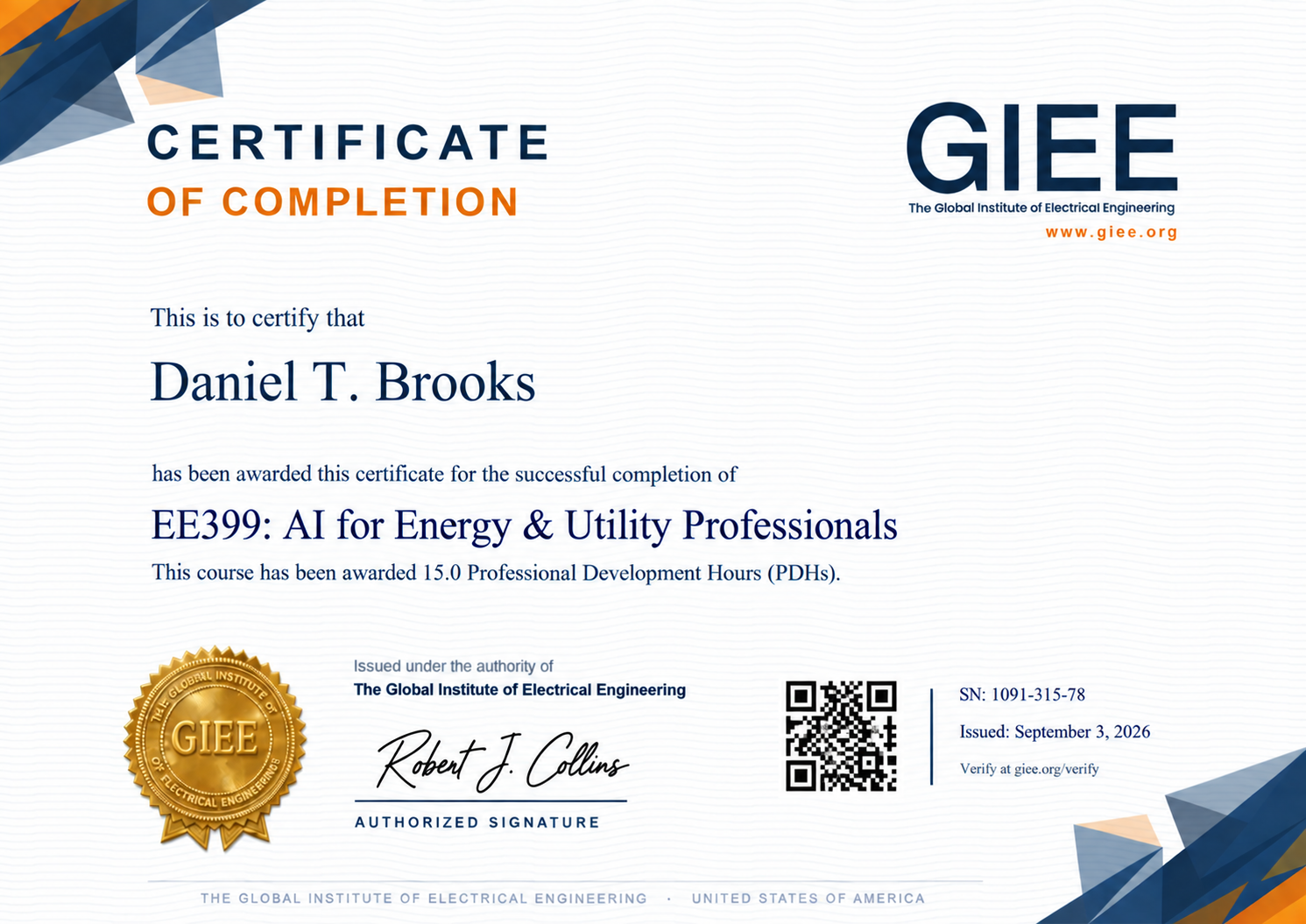
Sample certificate. Every GIEE certificate carries a unique serial number and can be verified at giee.org/verify.
AI has moved from a research topic to a daily working tool across the energy sector. EE399 is the accessible entry point to GIEE’s AI in Energy curriculum: it equips any professional working in or around the energy and utility industry to understand what modern AI actually is and to put today’s AI tools to work in their daily job. No programming, no mathematics, and no prior AI background required.
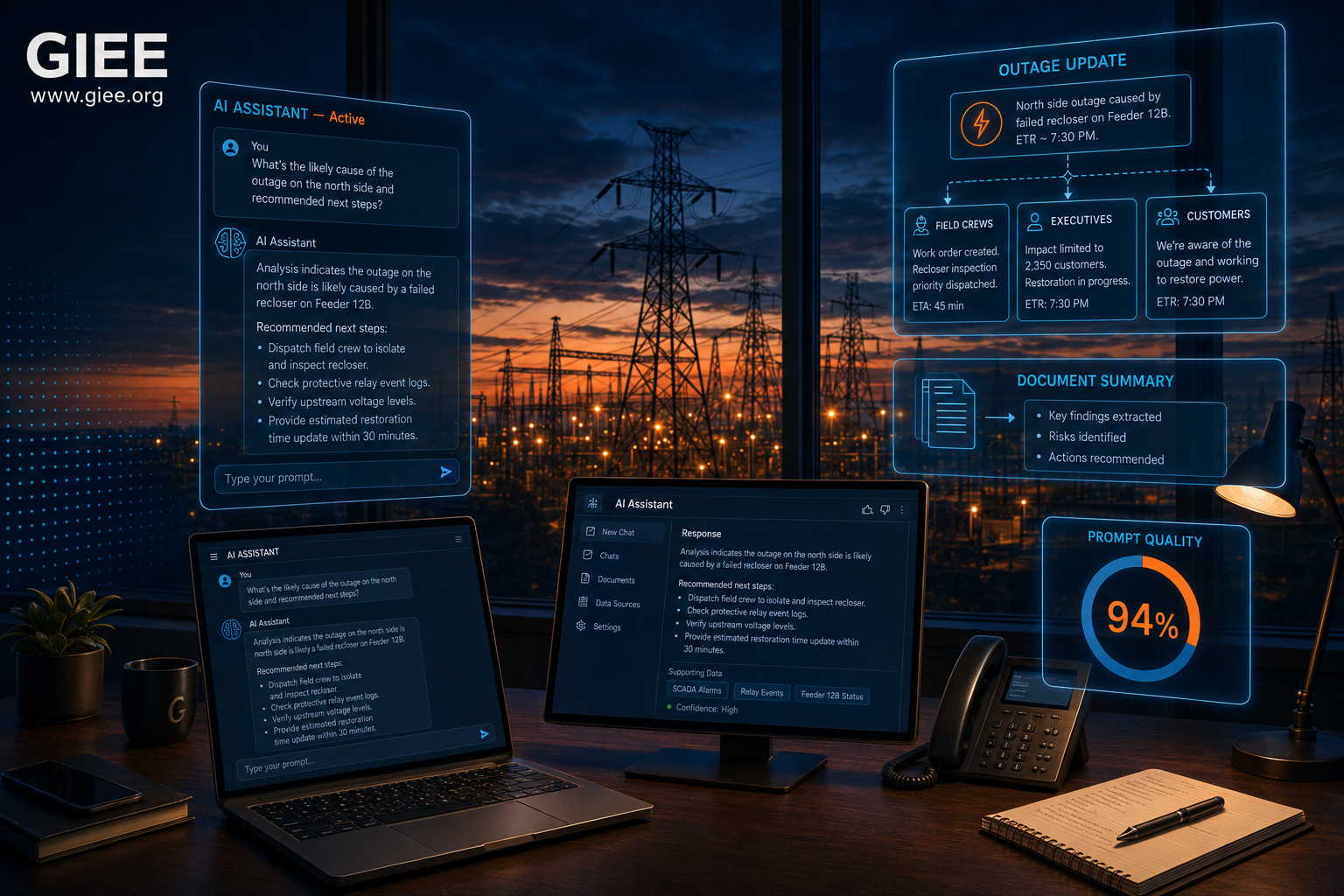
Every concept is taught Grid-First, with Energy Context. What AI can and cannot do is taught through real utility decisions. Prompt engineering is taught by turning a single outage update into tailored communications for field crews, executives, and customers. Safe AI use is taught through the confidentiality and critical-infrastructure constraints, including NERC CIP awareness, that utility professionals actually work under.
EE399 sits below the Core curriculum and carries no prerequisites. It is built for the broadest audience in the catalog: engineers and non-engineers alike, across power, generation, renewables, distribution, and markets. EE399 teaches you to use AI well; the Core curriculum, EE400 onward, teaches engineers to build it.
What You Will Learn
- Explain in plain language what AI, machine learning, generative AI, large language models, and AI agents are, and how they relate
- Distinguish what today’s AI can do reliably from what it cannot, and set grounded expectations for AI in utility and energy work
- Use leading AI assistants and specialized tools effectively for real work tasks across the energy sector
- Apply prompt engineering techniques to get reliable, high-quality results from AI systems
- Generate documents, summaries, analyses, diagrams, and charts to accelerate everyday professional work
- Query standards and equipment manuals in plain language, and summarize NERC and FERC documents into actionable briefings
- Handle AI outputs and confidential utility data safely, verifying results and respecting critical-infrastructure constraints
Course Structure
EE399 is organized into seven modules of short, stand-alone video units, plus a comprehensive final assessment.
- Module 1: Making Sense of AI. The vocabulary and the mental model. What modern AI actually is, how AI, machine learning, deep learning, generative AI, large language models, and AI agents relate, and what today’s systems can and cannot do.
- Module 2: How AI Tools Actually Work. A simple, non-mathematical look under the hood. Tokens, context windows, why the same prompt can give different answers, hallucinations, and knowledge cutoffs, so you can troubleshoot poor results instead of trusting or distrusting them blindly.
- Module 3: Prompt Engineering for Daily Work. The hands-on core of the course. Structuring prompts with role, context, task, and format, using examples, and iterating, closing with a complete worked example that turns one structured prompt into outage communications for three audiences.
- Module 4: Getting Real Work Done with AI. Applying the skills to real deliverables: documents, summaries, tables, diagrams, and charts, including querying long standards documents and manuals in plain language.
- Module 5: The AI Tool Landscape. An organized map of today’s AI assistants and specialized tools, and a practical framework for choosing the right tool for the job.
- Module 6: Using AI Safely. Verification habits, confidentiality, and CIP-aware data handling, so AI accelerates your work without putting sensitive utility information at risk.
- Module 7: Going Further. A look ahead at APIs, connected workflows, and the learning path into the Core curriculum for those who want to go deeper.
Grounded in Real Utility Work
Every lesson is anchored in real energy settings: utilities and market operators including Eversource, Duke Energy, PG&E, National Grid, ERCOT, and ISO New England, and the everyday tasks these organizations actually face, from multi-audience outage communications to summarizing NERC and FERC documents. Roughly 70% of examples come from the grid and utilities, 20% from renewables, and 10% from the broader energy industry. No generic AI demos; every example is grounded in energy work.
Who This Course Is For
- Utility and grid professionals in operations, planning, and engineering
- Renewables, markets, and storage professionals
- Technical, operational, and business roles across the energy sector
- Engineers and non-engineers alike; no technical background needed
- Anyone preparing to enter the Core curriculum, EE400 onward
Prerequisites
- None. This is the entry point to the curriculum
- No programming, mathematics, or prior AI background required
- Curiosity and a willingness to practice with AI tools
Format and Access
- Duration: 15 hours of structured instruction
- Format: Self-paced online, with short video units, live tool demonstrations, and quizzes
- Access: Six months of full access from enrollment
- Completion window: 90 days to complete the coursework and the final assessment
- Assessment: Seven module quizzes (40% of grade) and a comprehensive final assessment (60% of grade)
- Passing score: 70% overall
- Language: English
- AI tools: Central to this course and encouraged throughout; prohibited during quizzes and the final assessment
Where This Course Leads
EE399 is the on-ramp to the AI in Energy curriculum. It builds the practical fluency to use AI tools confidently in daily energy work, and it prepares those who want more for the Core curriculum, where engineers move from using AI to understanding and building it.
- EE400 and the Core curriculum. The engineering track that follows: AI fundamentals, data foundations, machine learning, and model evaluation, taught with the same Grid-First approach at full technical depth.
EE399 also stands entirely on its own. Professionals who simply want to work faster and smarter with today’s AI tools, without ever building a model, get lasting value from this course alone.